That Time I Turned a PowerPoint Into a Pillow

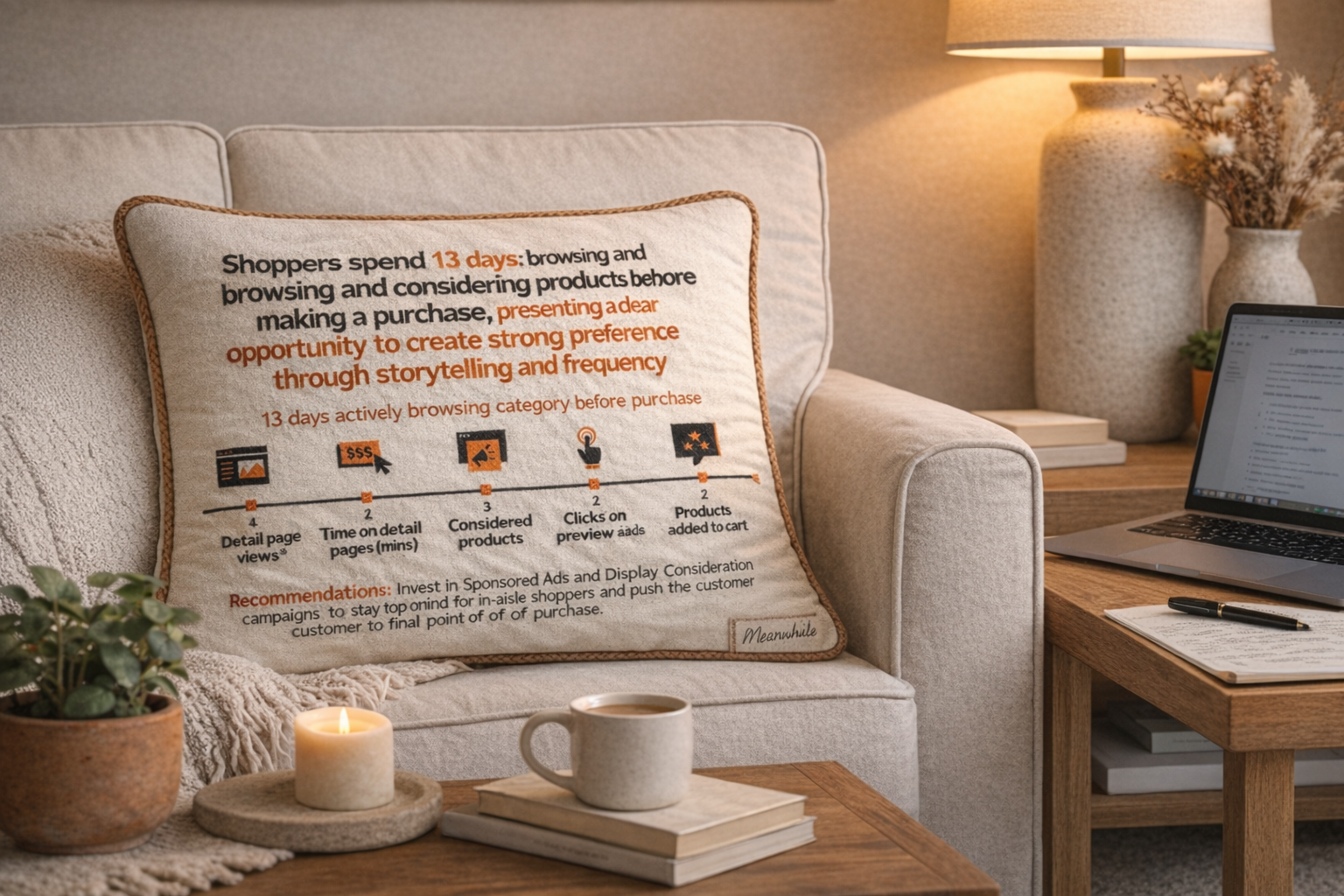
Part of me hesitated before writing this. Not because it felt extra, but because I didn’t want it to come across as braggy. The more I replayed it in my mind, though, the more I realized it wasn’t about a pillow at all. It was about paying attention to the little things. About taking a chance. About what happens when a team takes its own data seriously and has a little fun in the process.
Earlier this week, I joined a planning session with one of my clients. The kind of meeting that could easily default to slides, stats, and safe recommendations. At one point, a slide surfaced that quietly reframed the entire conversation. Not in brand language or aspirational creative, but in behavior.
Thirteen days in category before purchase.
Multiple detail page views.
Several products considered.
Review pages revisited.
Time spent comparing.
It was a clear picture of a consideration journey. This wasn’t an impulse category. It was a slow decision. A repeated decision. A measurable window of time where preference could either be built intentionally or left to chance.
Most teams would move past a slide like that quickly. It isn’t flashy. It doesn’t scream breakthrough. It’s disciplined data. But this team didn’t rush it. They treated that consideration window as an opportunity to design for presence, not just conversion.
And sitting there, I felt something unexpected.
I recognized myself in it.
Because I had been researching the exact product we were discussing. I had tabs open. I had read reviews. I had consulted ChatGPT. I had compared models and brands. I had revisited it over multiple days and driven my husband slightly crazy for close to two weeks talking it through. I wasn’t some abstract shopper in a dashboard. I was living inside that slide. The numbers weren’t theoretical. They were describing my behavior in real time.
It’s one thing to see a shopper journey mapped out in a presentation. It’s another to realize you’re actively moving through it.
Their Senior National Account Manager smiled and said, almost offhandedly, “I love this slide so much. I wish I could turn it into an embroidered pillow.”
Everyone laughed and moved on. I didn’t.
When you spend enough time working in e-commerce and retail media, you develop a reflex for translation. Ideas rarely stay abstract. A concept becomes a roadmap. A roadmap becomes an ASIN. An ASIN becomes a PDP. Eventually, that PDP becomes something that lives on a counter or inside a cabinet. Strategy does not remain theoretical for long.
So while the conversation continued, I opened a side tab and used AI to generate a visual mockup of what that embroidered pillow might look like. It took minutes.
That detail matters.
We live in a moment where technology allows us to collapse the distance between thought and execution almost instantly. A passing comment no longer has to stay hypothetical. You can translate it into something tangible in real time, even if that “tangible” thing exists only digitally.
There is always a line between thoughtful and performative, especially in partnership work. I try to be conscious of that line. But this didn’t feel like optics. It felt like appreciation made visible. A small way of saying, I see the thinking here. I see the work beneath the work.
The pillow does not exist. It was never meant to. The act of translation was the point.
At the end of the call, as we were wrapping up, the Director of Ecommerce shared something unexpected. As a thank you for the partnership, they would like to gift each of us a product from their small appliance line. Any current SKU.
The timing felt almost cinematic, but it wasn’t cause and effect.
The gesture wasn’t a response to a mockup created during the meeting. It was the reflection of years of work. Years of building trust. Years of showing up prepared and pushing past “good enough.” Years of caring about the details, even when no one was keeping score.
The pillow mockup happened to land in the same two-hour window. That’s the coincidence. The partnership is the foundation.
Strong partnerships are built on consistency, not clever moments.
They’re built on listening closely, exceeding expectations when it would be easier not to, and taking someone seriously even when they’re half-joking about embroidering a slide.
When you operate that way long enough, something shifts. Effort compounds. Trust deepens. Generosity becomes mutual rather than transactional.
Sometimes the return is subtle. Sometimes it’s simply more autonomy or deeper collaboration. And occasionally, the timing lines up in a way that makes the reciprocity visible.
That’s what happened here.
Not instant karma. Accumulated partnership equity.
Working in e-commerce and retail media gives you unusual exposure to products long before they ever reach a shopping cart. You see the engineering decisions, the bundling strategy, the pricing architecture, the subtle signals that differentiate premium from entry level. You understand the substance beneath the marketing, which means you rarely need convincing about quality.
That level of visibility requires discipline. It takes real self-control not to let professional exposure turn into personal accumulation. When you understand how thoughtfully something is built, the line between want and need becomes less about persuasion and more about restraint.
When the opportunity came to choose a product, the decision did not feel impulsive. It felt informed. I had already spent time understanding the architecture behind it.
Meanwhile, a slide became a pillow.
A comment became a prototype.
A moment of translation became something worth reflecting on.
The full product review will come later.
For now, this feels like the more interesting part of the story.
Sometimes the extra mile is not about leverage. It is about paying attention.
And attention compounds.