Forty-Two.

Today I turn forty-two.
When I was younger, I thought getting older meant accumulating answers. I pictured forty-two-year-olds as people who had life mostly figured out. They knew who they were, where they were going, and how they were going to get there. They had confidence, certainty, and a plan.
At forty-two, I can confidently report that this was not accurate.
What I have instead is perspective, and perspective turns out to be far more valuable than certainty.
In my twenties, I spent more nights than I’d like to admit crying over the gap between where I was and where I wanted to be. I didn’t have a degree. I didn’t have a roadmap. I didn’t have a clear picture of how any of it was supposed to work out. What I did have was a growing list of things that felt impossibly far away.
I wanted a successful career, but I couldn’t see a path to one. I wanted financial stability, but I wasn’t sure how to build it. I wanted a family, a home, and a life that felt meaningful, but from where I stood, those things seemed reserved for people who had advantages I didn’t have.
Looking back now, I can see how badly I underestimated what can happen over twenty years.
Many of those things eventually came to pass, but not in the way I imagined. There was no master plan, no perfectly executed strategy, and no moment where everything suddenly clicked into place. The path revealed itself one opportunity, one risk, one setback, one mistake, and one act of faith at a time.
That’s probably one of the biggest lessons age has taught me: most of life is only obvious in hindsight.
At twenty-two, I was staring at individual dots.
At forty-two, I can finally see some of the patterns.
The funny thing is that the patterns are rarely what I expected them to be.
When I was younger, I assumed success would solve uncertainty. I thought if I could just achieve enough, earn enough, accomplish enough, or become enough, I’d eventually arrive at some magical place where everything made sense.
Instead, I’ve discovered that every milestone simply changes the questions you’re asking.
At twenty-two, I was worried I’d never have the life I wanted.
At forty-two, I’m trying to learn how to steward the life I’ve been given.
Instead of wondering whether I’ll ever build a career, I think about how to lead well. Instead of wondering whether I’ll ever find my person, I think about how to be a better partner. Instead of wondering whether I’ll ever become a mother, I think about what kind of example I’m setting for the little girl watching me every day.
The questions have changed, but perhaps more importantly, so has the way I approach them.
One of the questions I’ve spent a surprising amount of time exploring over the years is why I am the way I am.
Like many people in corporate America, I was introduced to personality assessments through work. DISC. StrengthsFinder. Myers-Briggs. Enneagram. Every sales organization seems to have its preferred method of explaining human behavior.
Most people complete the assessment and move on.
I treated them like the beginning of a research project.
What started as workplace curiosity eventually became something much bigger. I wanted to understand why I think the way I do, why I obsess over systems, why I constantly look for patterns, why I connect dots that other people don’t seem to notice, and why some things come naturally while others feel unnecessarily difficult.
That curiosity eventually expanded beyond workplace assessments. It led to books, conversations, mentors, therapy, faith, AI, and more than a few rabbit holes along the way.
The deeper I’ve gone down those rabbit holes, the more I’ve realized I wasn’t really searching for labels. I was searching for patterns.
What fascinated me was never the framework itself. It was the possibility that there might be underlying connections between things that initially seemed unrelated. Why certain people are drawn to certain challenges. Why some lessons seem to repeat throughout a person’s life. Why we each appear to have unique gifts, weaknesses, motivations, and blind spots.
For much of my life, I thought my job was to overcome the way my brain works.
I spent years trying to be less intense, less obsessive, less anxious, and less prone to overthinking everything. I viewed many of those tendencies as flaws and assumed success would come from becoming less like myself.
What I’ve slowly come to understand is that many of the traits I spent years fighting are deeply connected to some of my greatest strengths.
The same brain that can get stuck in loops is also capable of seeing patterns other people miss. The same brain that can become fixated on a problem is also capable of building solutions. The same brain that constantly asks “why?” is the reason I’ve built a career helping organizations navigate complexity.
Age hasn’t eliminated those challenges, but it has helped me stop treating myself like a problem to solve.
The older I get, the less interested I am in becoming someone else and the more interested I am in becoming the healthiest version of who I already am. That shift has brought a surprising amount of peace.
It has also shaped my faith in ways I never expected.
The deeper I’ve gone in my search for patterns, the more appreciation I’ve developed for the Designer behind them. The more complexity I encounter, the harder it becomes for me to believe any of it happened by accident.
At twenty-two, I thought faith was mostly about answers. At forty-two, I find myself far more interested in wonder.
The older I get, the more comfortable I become with mystery. Not because I have fewer convictions, but because I’ve learned that certainty and understanding are not the same thing. Some questions are meant to be explored rather than solved.
That realization has made me more compassionate.
One of the unexpected outcomes of spending years trying to understand myself is realizing how complicated people really are, including me. The older I get, the harder it becomes to reduce people to simple explanations. Most strengths come bundled with weaknesses. Most weaknesses have roots that make more sense when you know the whole story. Most people are carrying struggles, fears, insecurities, and experiences that are completely invisible from the outside.
At twenty-two, I thought maturity meant becoming more certain.
At forty-two, I think it looks a lot more like becoming more curious.
This season of life has reinforced that lesson in ways I never expected.
If you had shown twenty-two-year-old Amy a snapshot of my life today, she probably would have focused on the obvious things: the career, the husband, the daughter, and the fact that I somehow built a life that once felt completely out of reach.
What would have surprised her most, though, is how wonderfully strange it all became.
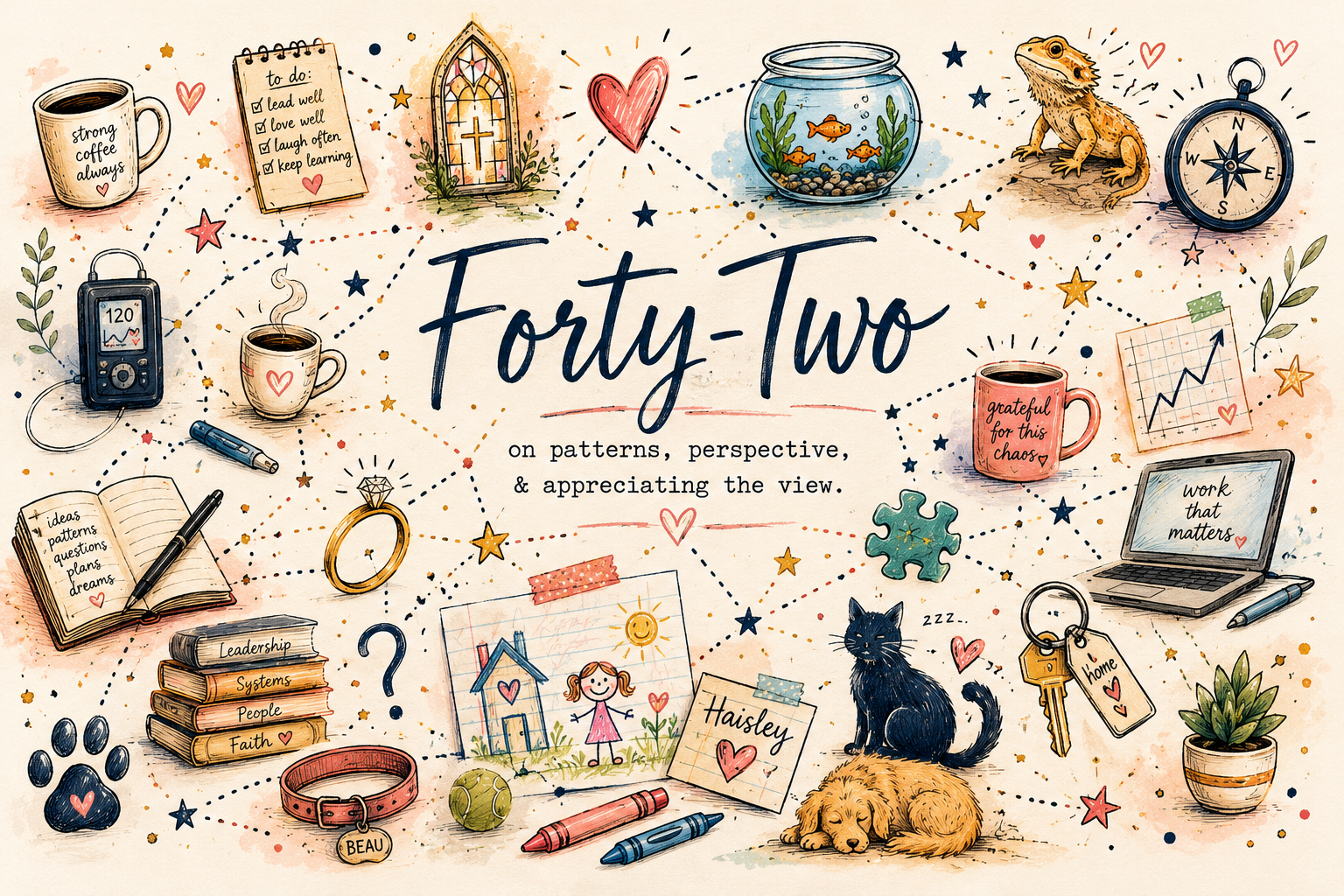
The Patterson household currently includes a three-year-old, three dogs, two cats, enough fish to qualify as a small public aquarium, and a bearded dragon named Neyland. Most days involve some combination of work deadlines, diabetes management, animal care, and answering questions from Haisley that would stump a philosopher.
None of that was part of the plan.
Thank God.
One of the things I’ve learned over the years is that the lives we end up loving rarely resemble the lives we originally imagined. They’re stranger, messier, more complicated, more expensive, more exhausting, and somehow more beautiful too.
The truth is that my life today is better than I imagined it would be.
It is also far from perfect.
There are still habits I need to improve, fears I need to confront, goals I haven’t reached, and dreams I’m still pursuing. There are still areas where I need to grow and relationships I could invest in more deeply.
One of the biggest surprises of adulthood is realizing that none of those things mean you’re failing. The people I admire most aren’t people who have arrived. They’re people who remain teachable. They continue growing, continue learning, and maintain enough humility to admit they don’t have everything figured out.
Maybe that’s what wisdom actually is.
Not having all the answers, but recognizing how much you still don’t know while remaining willing to learn.
When I look back across forty-two years, though, what stands out most isn’t the accomplishments.
It’s the people.
The older I get, the less I believe in the idea of self-made success. Every meaningful thing in my life traces back to people who invested in me: parents, grandparents, teachers, mentors, pastors, friends, and coworkers. They encouraged me when I needed encouragement, challenged me when I needed challenging, and carried me when I couldn’t carry myself.
Some of them are still here.
Some are not.
All of them left fingerprints.
The older I get, the more I realize that every life is shaped by a village, whether we recognize it or not. Mine is larger than I could ever adequately thank.
What surprises me most is realizing that somewhere along the way, I became part of someone else’s village too.
One day you’re the child being cared for, and then seemingly overnight you’re helping build the world someone else will inherit.
When I look at Haisley, I feel the weight of that responsibility. I also feel tremendous gratitude because I know she won’t be shaped by me alone. She’ll be influenced by grandparents, teachers, church friends, neighbors, mentors, and countless others who will leave fingerprints on her life the same way people left fingerprints on mine.
Perhaps that’s the biggest lesson forty-two has given me.
Life is less about arrival than I once thought. It’s more about stewardship, growth, relationships, and paying attention. It’s about recognizing patterns when they appear and having the humility to admit when they don’t.
Twenty-two-year-old Amy was terrified she wouldn’t get the life she wanted.
Forty-two-year-old Amy is sitting in a house occupied by a husband she adores, a three-year-old who talks about aliens in trees, three dogs, two cats, a small aquarium, and a bearded dragon.
She still has goals.
She still has worries.
She still has things to learn.
But she’s finally learned to appreciate the view.