My Gut Has a Search Warrant

A question popped up on LinkedIn the other day.
You could choose between two jobs. One was an at-will position with annual raises. The other was a five-year contract with no raises but a payout if you were terminated before the end of the agreement.
The comments looked exactly like you’d expect. Hundreds of people confidently explaining why their answer was the right one.
Meanwhile, I wasn’t really thinking about the jobs anymore.
I was thinking about the people answering the question.
At first I assumed everyone simply valued different things. Then it dawned on me that they weren’t actually solving the same problem. Someone with a year’s worth of savings wasn’t evaluating that contract the same way as someone living paycheck to paycheck. A parent with three kids wasn’t carrying the same risks as someone with no dependents. Someone in a booming industry wasn’t making the same calculations as someone whose job opportunities were much harder to come by.
The job never changed.
The people did.
And somehow that little LinkedIn poll turned into one of those moments where my brain wandered off into a completely different conversation.
I’ve started noticing that almost everything I do follows the same sequence.
First comes the hunch.
It’s never dramatic.
It’s usually just a quiet little…
“Hmmm.”
Something doesn’t fit.
Not enough to accuse anyone of anything. Not enough to reach a conclusion. Just enough that my brain quietly opens a file folder.
Earlier this year, that happened with a coworker.
I couldn’t have told you exactly what bothered me because there wasn’t one big thing. There were just tiny inconsistencies that didn’t seem to belong together. A timeline here. A conversation there. A detail that changed. Another one that didn’t quite match my memory.
Honestly, I was more suspicious of myself than anyone else.
Maybe I was reading too much into it.
Maybe I was connecting dots that weren’t actually connected.
So I didn’t jump to conclusions.
I started collecting evidence.
Weeks passed.
Every once in a while I’d notice another tiny detail and quietly toss it into the file folder. Most of them weren’t important by themselves. In fact, if you’d asked me to explain why something felt off, I couldn’t have done it.
Then one day the whole story came out, and my coworker was fired.
The part that stayed with me wasn’t that my gut had been right.
It was that I’d given it every opportunity to be wrong.
I think that’s an important difference.
People sometimes assume I’m incredibly data-driven.
I don’t think that’s quite it.
I’m evidence-driven.
My intuition points.
The evidence decides.
That pattern shows up everywhere in my life.
When my blood sugar suddenly spikes, I don’t immediately assume I counted carbs wrong. I start asking questions.
What changed?
Stress?
Sleep?
Hormones?
An infusion site?
Timing?
It’s basically diabetes CSI.
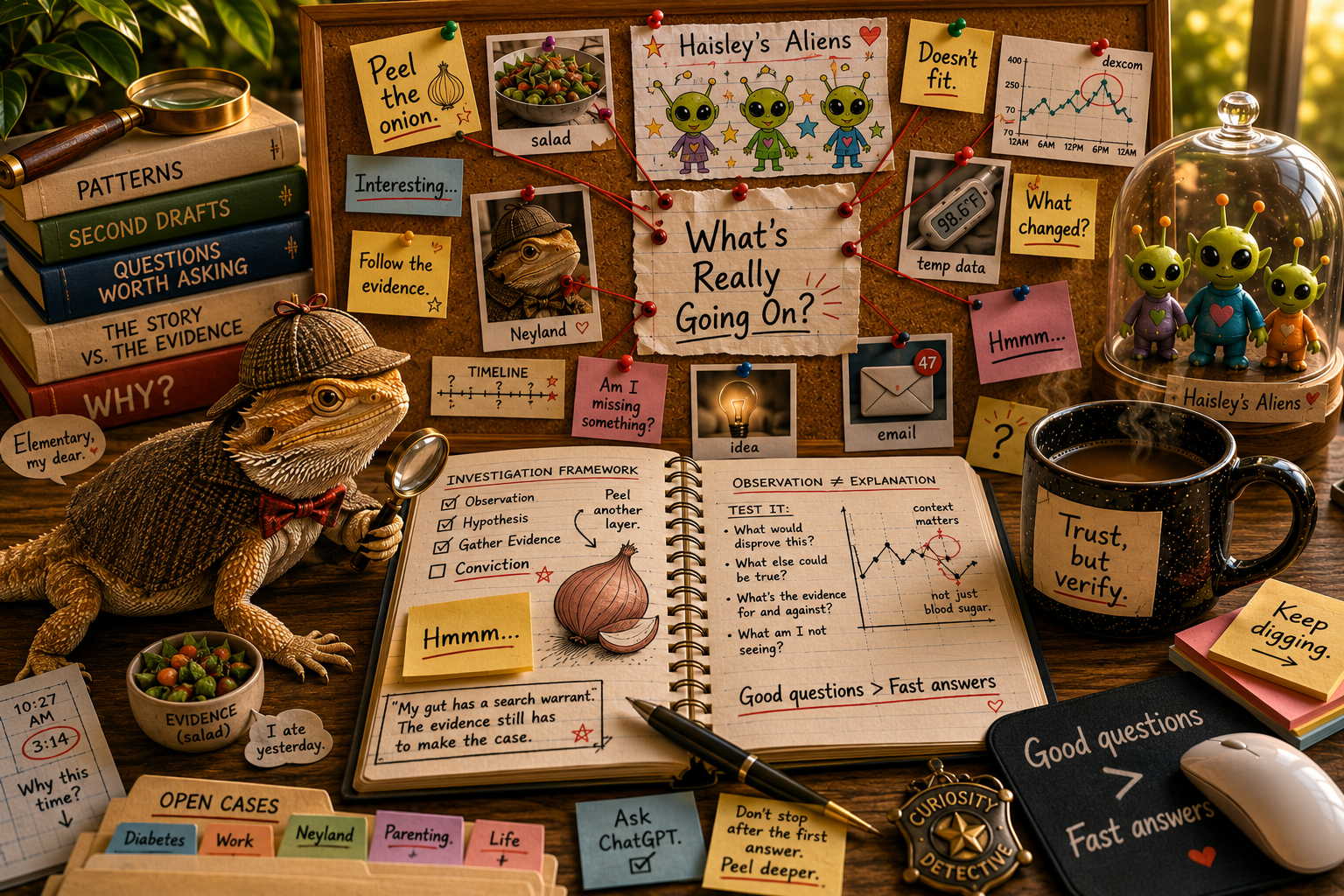
Jimmy has learned that if I suddenly go quiet and say, “Hang on…” there’s a decent chance an investigation has begun. Sometimes that investigation involves my Dexcom. Sometimes it’s an email from six months ago. Occasionally it’s a bearded dragon who has apparently decided that the exact same salad he inhaled yesterday is now beneath him.
Poor Neyland.
He’s just trying to be a lizard.
Meanwhile, I’ve got a mental corkboard with imaginary red string connecting lettuce to basking temperatures.
The funny thing is that I’ve spent years describing myself as analytical.
I don’t think that’s the whole story anymore.
I think my intuition is constantly generating hypotheses, and my analytical side insists they survive cross-examination before I’ll believe them.
That one realization has quietly changed how I think about almost everything.
Lately I’ve caught myself noticing how often we confuse observations with explanations.
“The client wants lower pricing.”
That’s an observation.
“The client is price sensitive.”
That’s an explanation.
Those two statements sound almost identical, but only one is something I actually know. The other is my brain trying to explain the evidence. It may turn out to be right.
It may not.
That’s why I’ve become oddly protective of a question I ask myself all the time.
What do I actually know?
Not what feels likely.
Not what would make a good story.
Not what my intuition is whispering.
What has the evidence actually earned the right for me to believe?
Ironically, asking that question hasn’t made me trust my intuition less.
It’s made me trust it more.
Not because it’s always right.
Because it knows its job.
My gut doesn’t get to be judge, jury, and executioner.
It gets a search warrant.
The evidence still has to make the case.
Writing this made me wonder if all of us have an operating system quietly running in the background.
Maybe yours isn’t intuition.
Maybe you instinctively notice beauty.
Or patterns.
Or emotions.
Or opportunities.
Maybe you’ve never stopped to think about it because it’s always just felt…normal.
But what if the way you naturally process the world has been shaping your decisions your entire life?
What question does your mind ask over and over again?
When your intuition speaks, what do you do with it?
How much evidence does it have to survive before you call it a belief?
I’ve spent years thinking I was trying to understand the world.
Now I think I was also learning how I decide what’s true.
And honestly…
I’m not sure which investigation has been more interesting.
P.S. An Experiment
If you’ve made it this far, here’s something I’d encourage you to try.
Open a conversation with your favorite AI and don’t ask it to solve a problem.
Ask it to help you understand how you think.
Not whether you’re right.
Not what decision you should make.
Just…how your mind works.
Here are a few prompts I’d start with:
- Based on our conversations, what patterns have you noticed in how I make decisions?
- What’s a question I ask repeatedly without realizing it?
- What’s something I consistently optimize for?
- When do I seem most confident? When do I hesitate?
- What assumptions do I tend to challenge? Which ones do I rarely question?
- What’s one blind spot you think I should investigate?
- If you had to describe my “operating system,” what would it be?
- When have I changed my mind? What caused me to change it?
- What’s something about me that I’ve never explicitly said, but you’ve inferred from our conversations?
- If you were writing a Meanwhile essay about the way I think, what would it be about?
One piece of advice, though.
Don’t stop after the first answer.
Push back.
Tell it where it’s wrong.
Ask it to peel another layer.
Ask for evidence.
Ask it what it’s missing.
The most valuable insights I’ve had with AI didn’t come from its first response.
They came from the twentieth.
Happy investigating.
—Amy