The Alien Tree

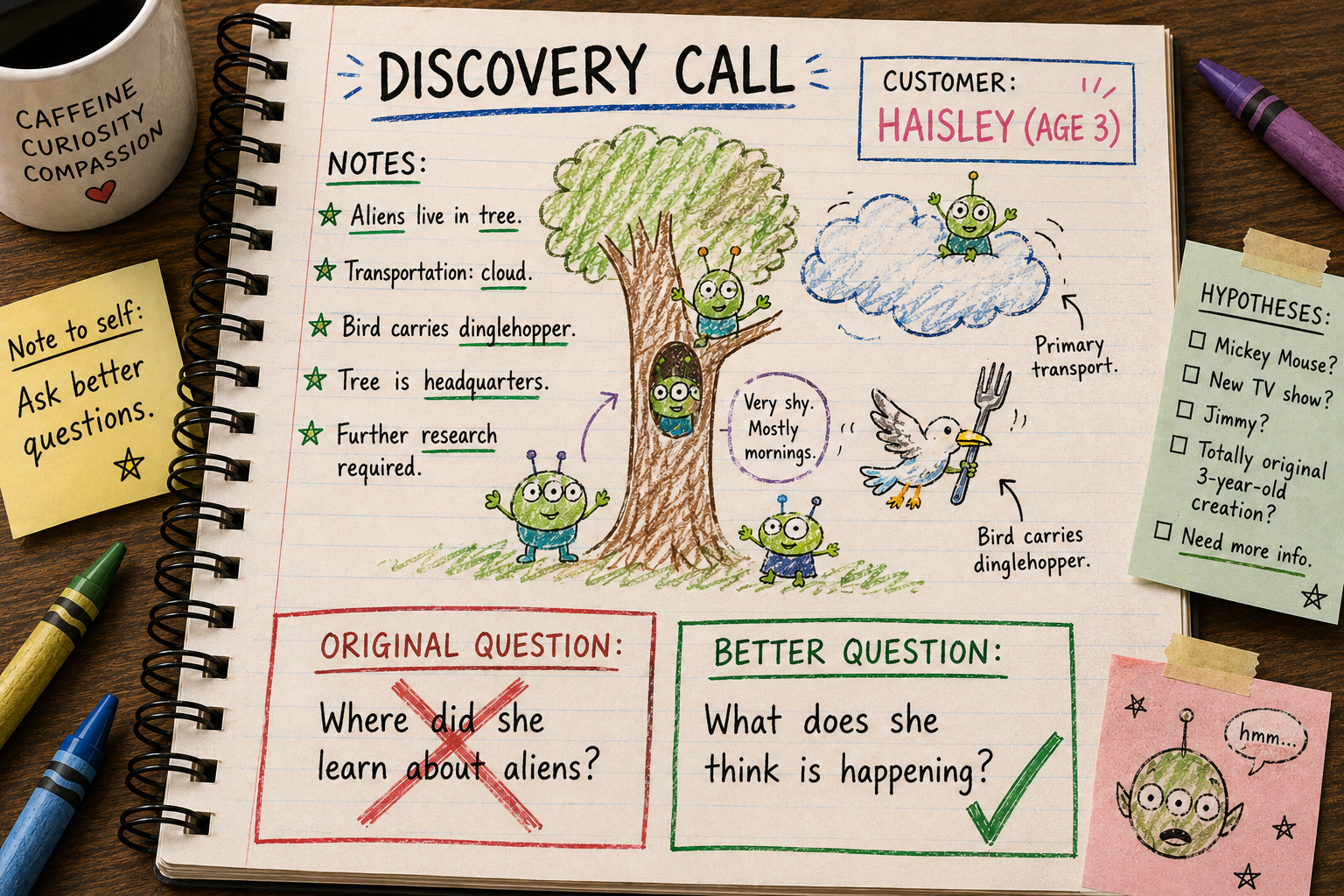
Last night, Haisley started talking about aliens.
Under normal circumstances, this wouldn't have made much of an impression. She's three, and three-year-olds say all kinds of things. Most of them disappear as quickly as they arrive.
This one stuck with me, though, because I was convinced there had to be a source.
Maybe it was a Mickey Mouse episode. Maybe it was something she'd seen on TV. Maybe Jimmy had planted the idea and was quietly enjoying the confusion from the sidelines. The whole thing had the feeling of an inside joke that everyone understood except me.
When I asked Jimmy about it, he looked just as confused as I was.
That should have been my first clue.
The next morning, on the drive to church, the aliens came up again. This time, I decided to get to the bottom of it.
One of the things people misunderstand about sales is that the best discovery calls aren't really about asking questions. They're about figuring out which questions matter. Clients rarely hand you a neatly organized explanation of their problem. Instead, they give you fragments, half-finished thoughts, and terminology that makes perfect sense to them but means something entirely different to everyone else in the room.
You start with what they've said. Then you keep pulling on threads until the real story emerges.
As it turns out, this skill transfers surprisingly well to conversations with three-year-olds.
Over the next twenty minutes, I learned that the aliens are green and live in a tree in our yard. Mickey Mouse knows about them and has apparently been searching for them. At some point, the aliens melted behind the tree, disappeared into a cloud, went somewhere else, and eventually returned because they didn't want to get wet in the rain.
At first glance, this information only raised additional questions.
But then I noticed something interesting.
Every time I asked Haisley to explain what happened, the story became more coherent, not less. The details weren't unraveling under scrutiny. They were becoming clearer. What initially sounded like complete nonsense was revealing itself to be a surprisingly consistent little world with its own rules, relationships, and logic.
The biggest breakthrough came when we got to the word melted.
Because the more she described it, the less it sounded like melting.
The aliens hadn't turned into puddles. They hadn't vanished permanently. They had simply been there, then somewhere else, and eventually back again.
What she meant wasn't melted.
What she meant was gone.
Or disappeared.
Or relocated.
Or maybe teleported.
The exact translation remains under review.
What became clear, though, was that she understood the concept perfectly. She just didn't have the exact word I would have chosen.
And suddenly I realized I wasn't conducting discovery on the aliens anymore.
I was conducting discovery on Haisley.
One of the strangest things about parenting is realizing that communication doesn't necessarily become easier once your child learns to talk. In some ways, it becomes more complicated.
When Haisley was a baby, I spent my time interpreting cries. Was she hungry? Tired? Uncomfortable? Every sound was a clue, and every day felt like a process of elimination.
Now I spend my time interpreting stories.
When she tells me she wants to "soft Neyland's brain," I know she means she wants to gently pet his head. She knows we tell her to be soft with animals. She knows Neyland has a head. She knows petting is an act of affection. She has all the pieces she needs. She's simply working with a vocabulary that is still under construction.
The same thing was happening with the aliens.
The longer we talked, the more I realized that I kept making the same mistake. I was assuming there had to be a reference I was missing. A show. A joke. A story someone else had started.
But more often than not, there isn't.
The source material is Haisley herself.
The aliens weren't copied from somewhere. They were assembled from pieces of things she knows and observations she's made. They live in a tree because things have homes. They came back because it was raining and they didn't want to get wet. Mickey is involved because Mickey knows things. The vocabulary is still developing, but the reasoning underneath it is remarkably logical.
At one point, I asked whether the aliens used dinglehoppers.
Haisley looked at me like I had completely misunderstood the assignment.
"No. Scuttle uses dinglehoppers."
The response was immediate and definitive.
And honestly, that may have been my favorite part of the entire conversation.
Not because it was funny, although it was. It was because it revealed just how much structure existed beneath the surface. She wasn't randomly mixing together Disney characters, aliens, and vocabulary words. In her mind, everyone had a role. Scuttle was responsible for dinglehoppers. Mickey investigated aliens. The aliens lived in the tree.
I was the one trying to merge departments that had no business being merged.
By the time we arrived at church, I felt like I had a reasonably solid understanding of the situation.
Which made what happened next even funnier.
After spending the entire drive conducting what felt like a highly productive discovery session, Haisley walked into church and loudly announced that she couldn't find the aliens.
A new family happened to be visiting that morning, and I remember briefly wondering what they must think was happening in our household.
Meanwhile, I was standing there thinking that the situation was actually much more nuanced than that.
Because by then, I understood that the aliens hadn't simply disappeared. They had temporarily relocated using cloud-based transportation before returning to their tree due to weather conditions.
At least, that's my current understanding.
I'm still waiting for final confirmation from the subject matter expert.
The older she gets, the more I realize that a surprising amount of parenting has very little to do with having answers and everything to do with listening carefully enough to understand what she's trying to tell me before I rush in with my own assumptions.
Because whether I'm talking to a client, a coworker, or a three-year-old explaining the migration patterns of backyard aliens, the same principle usually applies:
The first answer is rarely the whole story.
You have to stay curious long enough to discover what people actually mean.
And if today's discovery call is any indication, the Patterson backyard is currently home to a colony of green aliens, Mickey Mouse is investigating, and Scuttle remains the sole recognized authority on dinglehoppers.
Honestly, I've sat through less organized meetings.
Postscript: Shortly before bedtime, we achieved a breakthrough.
Visual confirmation was obtained that the aliens originated from Toy Story.
This discovery was deeply satisfying to the part of my brain that likes root causes, source documentation, and understanding where ideas come from. After spending most of the day convinced that either Mickey Mouse or Jimmy was somehow involved, it was nice to finally identify at least one source.
Unfortunately, as often happens during discovery, answering one question created several new ones.
The aliens are now apparently associated with flowers.
They still live in the tree.
Mickey is still involved.
Cloud-based transportation remains operational.
And according to Haisley, Scuttle continues to serve as the sole recognized authority on dinglehoppers.
In other words, we successfully identified one of the ingredients but are still missing the full recipe.
The current working theory is that the aliens came from Toy Story, the tree came from our backyard, the rain came from real life, Mickey wandered in from somewhere else entirely, and Haisley assembled all of it into a story that is now uniquely her own.
The Alien Investigation Team will continue to monitor the situation and provide updates as new intelligence becomes available.