Life Between the Numbers

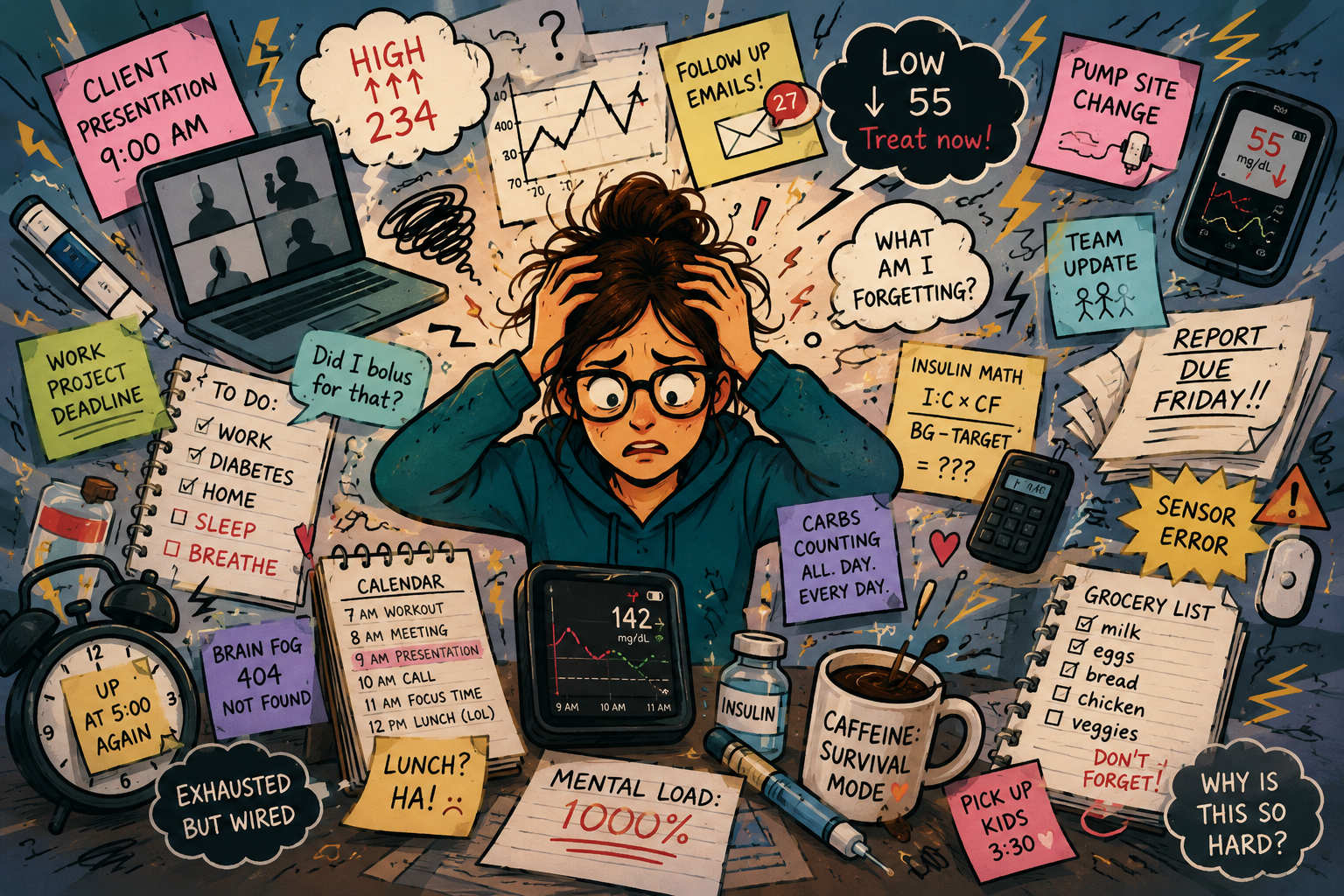
Today, my diabetes technology staged a full-scale rebellion.
While I was in the middle of a client presentation, my continuous glucose monitor insisted I was headed low. The alarm screamed at me repeatedly. My insulin pump responded accordingly. I treated what I believed was an impending low because, frankly, there wasn't much choice. The meeting wasn't going to stop because my blood sugar had other plans.
An hour later, two finger sticks revealed my glucose wasn't low at all.
It was over 200.
The sensor rejected my calibration. The replacement website broke. By the end of the day, my glucose meter and continuous glucose monitor couldn't even agree on which reality we were living in. The Sacred Timeline had apparently branched.
Meanwhile, the presentation still happened. The client still had questions. The emails still needed answers. My daughter still needed dinner and a bedtime story.
Life kept moving.
As frustrating as the day was, it reminded me of something I've been thinking about a lot lately: for most of my adult life, I thought diabetes was supposed to feel this way.
Not the alarms or the technology.
The fog.
The fatigue.
The feeling that some days my brain was operating at 70% capacity for reasons I couldn't quite explain.
I assumed that was simply part of having diabetes. I also assumed I had Type 2 diabetes because that's what I'd been told in my twenties. It would take nearly twenty years before I learned that both assumptions were wrong.
At 41, I was diagnosed with LADA, or Latent Autoimmune Diabetes in Adults. If you've never heard of it, you're not alone. Most people haven't.
LADA is an autoimmune form of diabetes that develops in adulthood and is frequently mistaken for Type 2. On the surface, it can look remarkably similar. The progression is often slower than classic Type 1 diabetes, which means many people spend years, sometimes decades, being treated for Type 2 before anyone realizes something else is happening.
I was one of those people.
Looking back, there were clues. Blood sugars that never behaved the way they should. Medications that didn't always deliver the expected results. A persistent feeling that I was working harder than I should have had to for outcomes that still didn't make sense.
Part of what made that so difficult was the baggage that often comes with a Type 2 diagnosis.
To be clear, there is nothing wrong with having Type 2 diabetes. Millions of people live with it every day, and managing it is no less real or challenging than any other form of diabetes.
But the two diagnoses are often viewed differently. Type 1 is generally seen as something that happened to you. Type 2, fair or not, often comes with an unspoken assumption that you somehow caused it—or could fix it if you just tried harder.
Live with that long enough, and those assumptions can become your own.
So when something doesn't make sense, you don't question the diagnosis. You question yourself.
You assume you need to lose more weight, eat better, exercise more, or somehow become more disciplined than you already are. Every blood sugar that doesn't make sense becomes evidence that you're failing instead of evidence that something else might be going on. You spend years trying to fix yourself when the reality is that you're trying to manage the wrong disease.
Realizing that was life-changing, but it wasn't the biggest surprise. The bigger surprise came afterward, when I began to understand how much of my life had quietly been organized around recovery without me ever recognizing it.
People tend to think about diabetes in terms of complications, medications, and A1C results. Those things matter, but they aren't what most people experience on a random Tuesday afternoon. What most people experience is the cognitive side of diabetes.
High blood sugar doesn't always feel dramatic. Sometimes it feels like trying to think through a layer of static. It feels like struggling to access information that you know is in your head somewhere. It feels like your brain is operating with a dozen browser tabs open and none of them are responding.
Low blood sugar is different, but equally disruptive. The shakiness. The urgency. The inability to focus on anything except solving the immediate problem in front of you.
And neither one ends when the number changes.
The glucose comes down. The glucose comes up. But your brain and body still have to recover, and nobody talks enough about that recovery period. We talk about highs and lows as though they're isolated events when, in reality, much of life with diabetes is spent recovering from the last swing while trying to prevent the next one.
That's the part I never understood when I was younger.
I knew highs weren't good. I knew lows weren't good. What I didn't understand was how much of my life existed in the space between them.
There was the mental static that lingered after a high, the exhaustion that followed a low, and the constant effort of trying to decide whether a number needed action or whether it was better left alone.
None of those things are dramatic enough to make for a commercial, but over weeks, months, and years they add up. Eventually you realize you're spending a surprising amount of your life recovering from diabetes instead of simply living with it.
And that recovery doesn't stop when it's time to eat. If anything, meals are where the cycle begins again, because every decision about food becomes another calculation, another prediction, and another opportunity for things to go differently than you expected.
I used to be a foodie. I loved trying new restaurants, ordering the thing I'd never had before, splitting appetizers, sampling whatever everyone else ordered, and treating food as an experience instead of a calculation. Food was fun. Food was spontaneous.
These days there are moments when I genuinely wish every meal came with a barcode and a nutrition label, or better yet, that someone could compress it into pill form and let me move on with my day.
That sounds ridiculous until you understand what eating with insulin actually requires. Most people assume counting carbs is the hard part, but the real challenge is that every meal forces you to predict the future.
I need to estimate how many carbohydrates are in the food, but that's only the beginning. I also need to consider how quickly they'll hit my bloodstream, how much fat and protein might delay absorption, whether I'm about to spend the next six hours walking around Disney or sitting through back-to-back meetings, how much insulin is already active in my system, and whether my blood sugar is currently rising, falling, or holding steady.
And then there's the biggest wildcard of all: me.
Sometimes my eyes are bigger than my stomach. I dose for what I think I'm going to eat and then get halfway through the meal before realizing I'm full. Now I have insulin working for food I never actually consumed.
Other times I go the opposite direction. After enough lows, it's easy to become conservative. To shave a few carbs off the estimate because being a little high feels less scary than being low. Then I spend the next few hours chasing a number I was trying to avoid in the first place.
The reality is that diabetes turns eating into an exercise in forecasting. Every meal is a prediction made with incomplete information, and sometimes the prediction is wrong no matter how carefully you make it. Food doesn't always digest the way you expect. Activity changes things. Stress changes things. Hormones change things. Sometimes I do everything exactly right and still end up wrong.
That's one of the reasons I became borderline obsessive when I decided to switch from Omnipod to the Tandem Mobi. The systems thinker in me was fascinated. I spent months researching, reading studies, comparing algorithms, watching reviews, following user experiences, and gathering data. By the time I finally made the switch, I had probably invested enough hours to earn a minor in diabetes technology. I wasn't looking for a better graph. I was looking for a better life. I wanted to know whether all the hours I'd spent researching algorithms, comparing systems, and obsessing over the decision would translate into something that actually mattered in day-to-day life.
The answer arrived faster than I expected. The graphs looked better, sure, but what surprised me most was how quickly I noticed the difference away from the data. Meetings felt easier. Long days felt less draining. I felt more focused, more consistent, and more like myself.
It took me a while to understand why.
For years, I had quietly organized large portions of my life around recovery. Recovery from highs. Recovery from lows. Recovery from correcting the high that followed the low. Recovery from the fog, fatigue, and mental static that I had accepted as normal for so long. I didn't think of it that way at the time, of course. I just assumed that was life with diabetes. It wasn't until things improved that I realized how much of my energy had been spent climbing back to baseline.
That's why today's sensor failure bothered me more than it normally would have. It wasn't just the bad reading or even the false alarms.
It was the sudden return of uncertainty.
The moment the data became unreliable, diabetes immediately demanded center stage again. The calculations returned. The second-guessing returned. The constant mental negotiations returned. Every decision suddenly required more thought, more effort, and more attention.
By the end of the day, I wasn't exhausted by my blood sugar itself. I was exhausted by thinking about my blood sugar, constantly evaluating it, second-guessing it, and deciding what to do next. That's what I wish more people understood: diabetes isn't just about blood sugar. It's about the cognitive load that comes with managing it every waking hour.
It's about carrying a second job in your head while simultaneously trying to be a parent, spouse, friend, employee, manager, and functioning adult. That second job shows up in a hundred different ways: trying to focus on a client presentation while your devices insist you're low, doing math before every meal, making decisions with incomplete information, and knowing you'll occasionally get it wrong no matter how hard you try.
It's about making hundreds of decisions that nobody else sees, and sometimes it's about discovering, twenty years later, that you've been trying to solve the wrong equation.
So if you're reading this and your diabetes story has never quite made sense, ask questions. Advocate for yourself. Learn about LADA. Ask about antibody testing. Ask about C-peptide testing. Ask why your diabetes behaves the way it does.
Because while LADA isn't as well known as Type 1 or Type 2, it is far more common than most people realize. Many adults spend years being treated for Type 2 before discovering they're actually dealing with an autoimmune disease. I was one of them.
If sharing my experience helps even one person get the right diagnosis sooner than I did, then maybe twenty years of confusion wasn't entirely wasted.
Meanwhile, life goes on.
The meetings will continue, the emails will keep coming, and my toddler will still want another bedtime story before bed. The alarms will inevitably go off at the least convenient possible moment, and diabetes will continue to demand attention whether I have time for it or not.
The difference is that now I understand what I'm actually fighting. More importantly, I finally know what it feels like when diabetes takes up less space in my head, leaving more room for everything else that matters.