In the Back of the Sanctuary

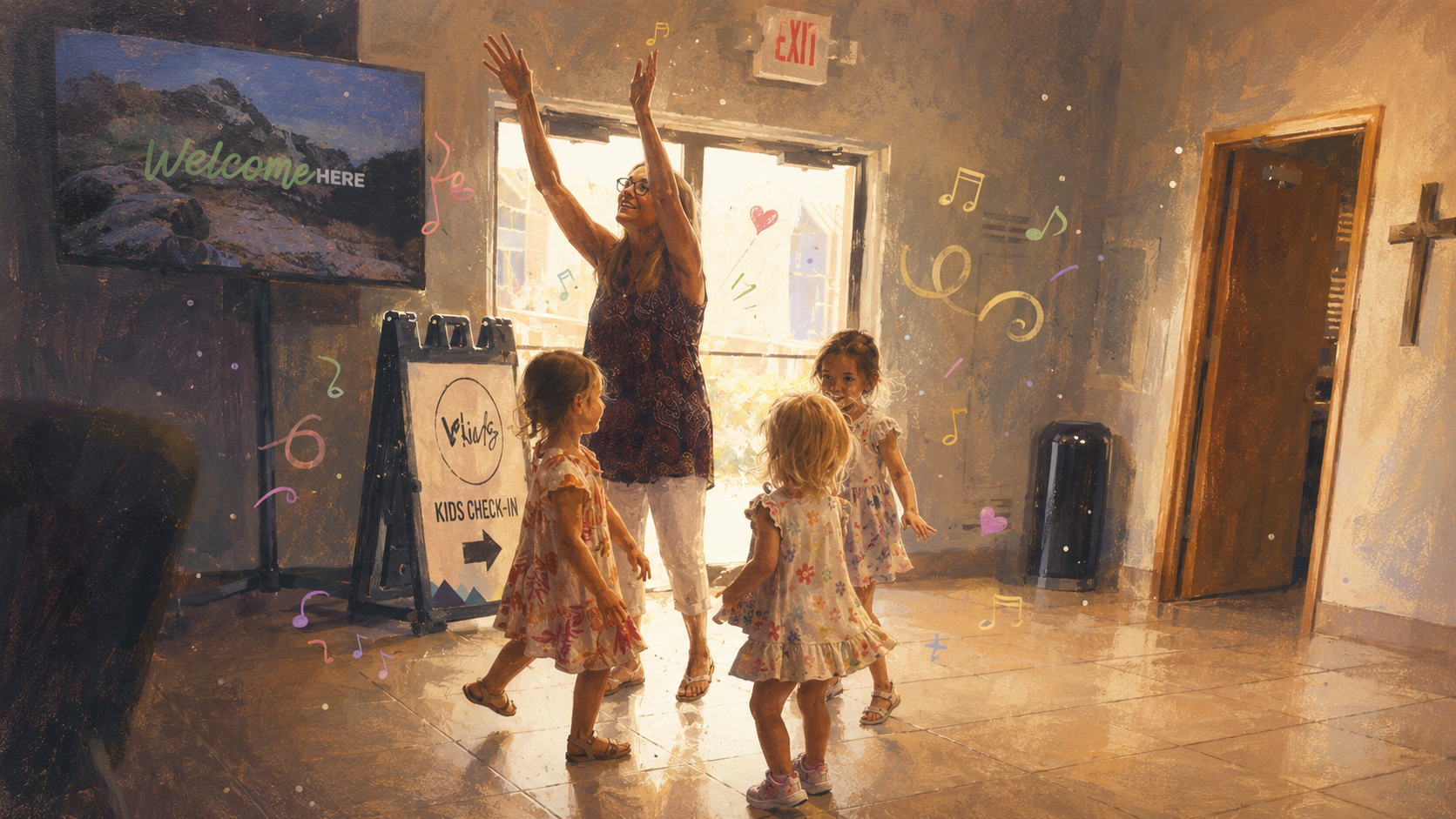
This morning, while most of us were finding our seats and waiting for service to begin, three little girls were dancing in the back of the sanctuary with Ms. Connie.
Haisley was one of them.
The girls couldn’t have been more than three or four years old. They spun in circles, bounced to the music, and copied every move Ms. Connie made. When she raised her hands toward the ceiling, they raised theirs. When she laughed, they laughed. For a few minutes, they created their own little world in the corner of the church, completely unconcerned with who was watching.
Most people would probably look at that scene and think, “That’s sweet.”
And it was.
But the longer I watched, the more I realized I wasn’t really watching three little girls dance. I was watching three little girls dance with Ms. Connie, and that distinction felt important.
The girls know Ms. Connie as the woman who is always happy to see them. She knows their names. She stops what she’s doing to talk to them. She gets down on their level. She smiles easily. She makes church feel familiar.
What they don’t know, at least not yet, is everything that came before them.
They don’t know about the years she spent raising daughters of her own. They don’t know about the prayers she has prayed, the burdens she has carried, the moments that shaped her, or the heartbreaks that left their mark. They don’t understand that every older person they meet is carrying an entire lifetime of stories that existed long before they arrived.
Children never think about things like that.
When you’re three years old, joy is simply joy. A smile is simply a smile. The people you love are the people who make you feel safe, seen, and welcome. You don’t stop to wonder what made them who they are.
As adults, we know better.
We know that some people arrive at joy the easy way, while others arrive there by walking straight through heartbreak and choosing not to let heartbreak have the final word.
We know that faithfulness is rarely formed during the easy seasons of life. It is formed in hospital rooms, at gravesides, through unanswered questions, and in the quiet moments when people decide that even though they cannot control what happens to them, they can still control who they become.
That was the thought I couldn’t shake while watching the girls dance with Ms. Connie.
The girls saw a woman dancing.
I saw a woman who had every reason not to.
The girls saw joy.
I saw the kind of joy that has been tested.
The girls saw someone raising her hands in worship.
I saw decades of choosing faith over and over again.
Maybe that’s why the moment affected me so deeply. The girls had no idea they were receiving anything beyond a few minutes of fun before church. They weren’t thinking about grief, perseverance, legacy, or faithfulness. They were just being children.
But that’s often how the most important lessons are learned.
Through proximity.
A child spends enough time around someone and slowly begins to absorb what that person’s life teaches. They learn what kindness looks like. What generosity looks like. What worship looks like. What joy looks like.
And perhaps most importantly, they learn what it looks like to keep going.
We spend a lot of time talking about children’s ministry as though it primarily happens in classrooms. We invest in curriculum, volunteers, lesson plans, and activities. All of those things matter.
But some of the most important discipleship happens in moments nobody planned.
It happens in church hallways.
At potlucks.
During conversations after service.
And sometimes it happens when three little girls decide to dance with a woman who has spent a lifetime following Jesus.
The older I get, the more convinced I become that the Church’s greatest strength isn’t found in its programs. It’s found in its people.
The people whose names may never appear on a stage but whose fingerprints are somehow everywhere.
The people who remember birthdays, notice absences, welcome new families, and instinctively know when someone needs encouragement.
The people who make a church feel like home.
People like Ms. Connie.
As I watched her with the girls, I found myself wondering whether people like Ms. Connie are becoming increasingly rare.
Not because they’re better than younger generations, and not because the world was somehow perfect when they were growing up.
But because they were formed in an era that still understood the value of staying.
Staying in relationships.
Staying in communities.
Staying in churches.
Staying long enough to become part of other people’s stories.
Today, we live in a world built around convenience. We can order groceries from our phones, stream almost any movie ever made, and have packages delivered to our doorsteps within hours. We are surrounded by tools designed to eliminate waiting, reduce friction, and give us exactly what we want when we want it.
None of those things are inherently bad.
But there are some things that cannot be expedited.
Trust cannot be expedited.
Character cannot be expedited.
Faithfulness cannot be expedited.
The kind of influence that causes three little girls to run toward you the moment they see you cannot be expedited.
That is accumulated slowly over years and decades of showing up.
Week after week.
Year after year.
One ordinary Sunday at a time.
Perhaps that’s why moments like this move me so deeply.
I wasn’t simply watching three little girls dance with a woman from church.
I was watching the accumulated result of a life spent showing up.
One day Haisley probably won’t remember this specific Sunday morning. She won’t remember what song was playing or what shoes she wore. She probably won’t remember dancing in the back of the sanctuary.
What she will remember is how church felt.
She will remember that there were adults who knew her name and were genuinely glad she was there. She will remember that worship felt joyful. She will remember that church was filled with people who loved her even though they didn’t have to.
And somewhere in those memories will be Ms. Connie.
Not because she stood on a stage.
Not because she sought recognition.
But because she consistently offered children the gift of her presence.
As I watched those three little girls dancing this morning, I couldn’t help but think that they were receiving something precious without even realizing it.
They thought they were dancing with Ms. Connie.
What they couldn’t possibly understand is that they were dancing with decades of faithfulness. They were dancing with a woman whose life had taught her that joy and sorrow can coexist. They were dancing with the kind of grace that can only be learned by loving deeply and continuing to love anyway.
One day they’ll be old enough to understand that every older person carries a story. They’ll learn that some smiles are hard-earned. They’ll discover that the people they admire most are often the people who have suffered the most and somehow emerged softer instead of harder.
And if they’re lucky, they’ll realize they once danced with one of those people.
Standing there watching them, I had the unmistakable feeling that I wasn’t witnessing something ordinary.
I was witnessing one generation quietly passing something sacred to the next.