Fixing Things

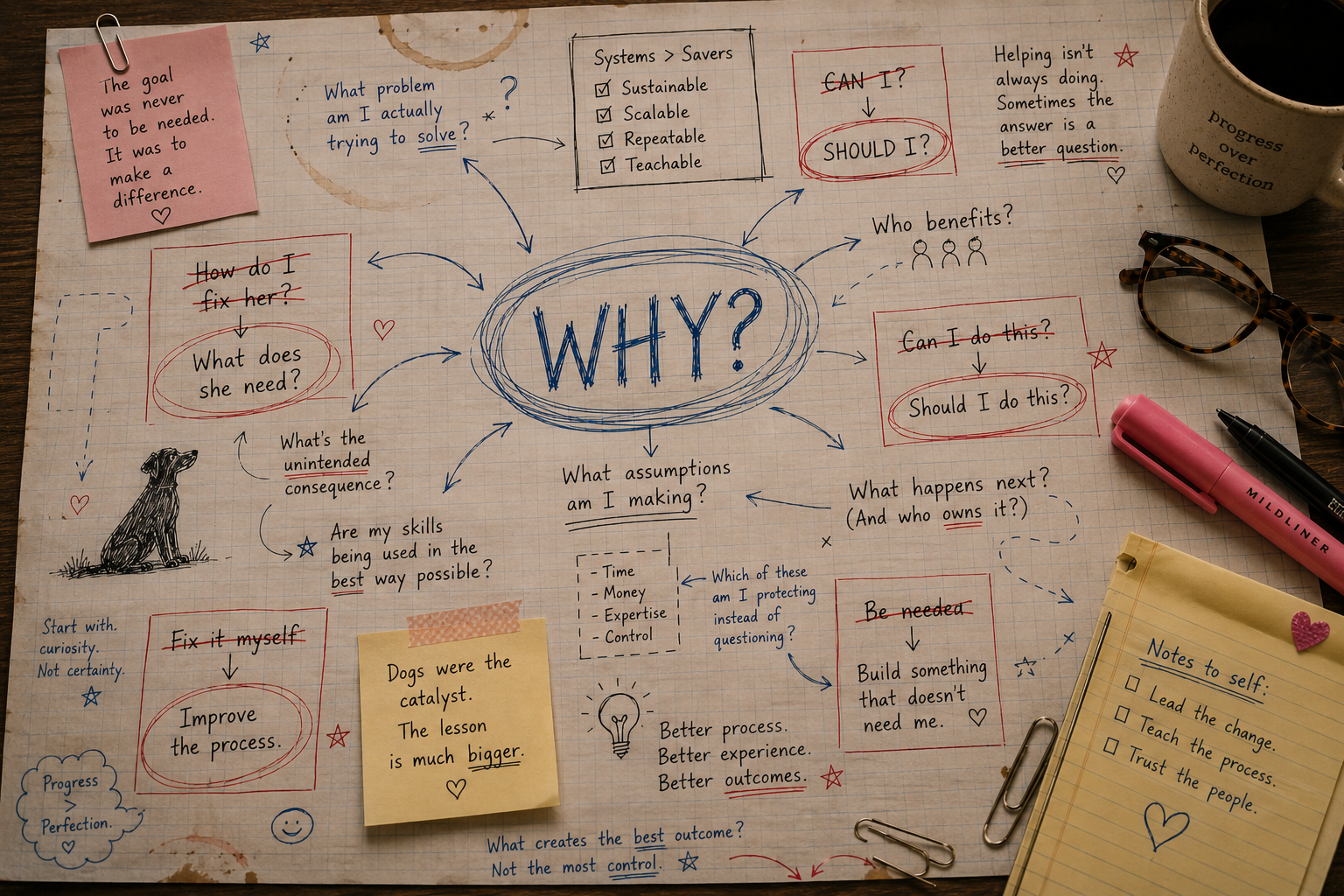
Earlier this morning, before Haisley was awake and before my first call of the day, I published All the Dogs I've Ever Loved.
That essay was about a dog named Gia, but it wasn't really about Gia. It was about compassion, compatibility, and the realization that loving a dog and being the right home for that dog aren't always the same thing.
After clicking publish, I also sent an email to the shelter we had visited.
I wasn't angry, and I certainly wasn't trying to get anyone in trouble. If anything, I wanted to acknowledge that everyone involved was working toward the same goal: finding dogs lasting homes. I just couldn't shake the feeling that the adoption process was sometimes asking the wrong questions. So I wrote about what I'd observed, why I thought it mattered, and how better matching a dog's behavioral needs with an adopter's experience and lifestyle might ultimately lead to better outcomes for everyone involved.
Later this morning, I opened my inbox to find a thoughtful response from the shelter manager. He thanked me for taking the time to write, said my feedback had already been shared with the leadership team, and explained that they were continually evaluating and refining their adoption matchmaking process.
I smiled, closed the email, and went back to work.
It wasn't until later, somewhere between meetings, that I realized why the whole experience had stayed with me.
Old Amy would've adopted Gia.
Not because she was the right dog for me, but because I would've convinced myself I could become the right person for her.
That's an uncomfortable sentence to write because I know exactly where that instinct came from. It came from a good place. For a long time, I genuinely believed that if I had enough experience, enough patience, enough love, enough time, I could help almost any dog.
Sometimes I could.
Sometimes I couldn't.
I've spent years training dogs, fostering dozens of dogs and puppies, competing in AKC sports, working in veterinary medicine, and sharing my home with everything from pit bulls to an Australian Shepherd who routinely reminded me that intelligence and good decision-making aren't always the same thing, to a 120-pound working-line livestock guardian dog that quietly became Haisley's best friend. Somewhere along the way, all the dogs I've ever loved—and a few I only borrowed for a little while—changed the way I look at the next one.
Some of those dogs were wonderfully easy. Others stretched me farther than I ever imagined possible. They taught me about behavior, patience, boundaries, grief, resilience, and the uncomfortable reality that sometimes loving something with your whole heart still isn't enough to change the outcome.
I don't think I fully understood how much those experiences had shaped me until I met Gia.
It also occurred to me that this wasn't really about dogs.
Earlier this year I stepped into a completely new season of my career. For the first time in a long time, success stopped being measured primarily by my own results. Suddenly I was responsible for helping other people succeed, and I've learned pretty quickly that the skills that make someone a strong individual contributor don't automatically make them a strong leader.
For most of my career, I built my reputation on solving problems. If a deal was going sideways, I'd jump in. If a client relationship was strained, I'd get involved. If a process was broken, I'd fix it. It was rewarding because the feedback was immediate. You solved the problem, everyone moved on, and you got to be the person who made things better.
Leadership has been forcing me to rethink that.
I'm learning—emphasis on learning—that the goal isn't to become the person who fixes every problem. It's to become the person who builds people, systems, and processes that prevent the same problems from happening over and over again.
That's slower work.
If I'm being honest, it's also much less satisfying in the moment. Coaching someone through a decision rarely gives you the same sense of accomplishment as making the decision yourself. Redesigning a process isn't nearly as exciting as swooping in to save the day, and sometimes you never even get to see the impact because it shows up quietly in the absence of future problems instead.
But I think it lasts longer.
The more I sat with the shelter experience, the more I realized that's exactly what had changed.
Years ago, my brain would've immediately started building a rehabilitation plan for Gia. I'd have been thinking about confidence-building exercises, counterconditioning, management strategies, enrichment, veterinary behaviorists, and training goals before we'd even left the meet-and-greet room. My instinct would've been to take ownership of the problem because that's how I understood helping.
Yesterday, instead of taking Gia home, I wrote an email.
Not because an email will help Gia more than I could.
It won't.
But maybe it helps the next Gia.
Maybe it helps the next family.
Maybe it encourages someone to ask one more question before making a forever decision.
Maybe it nudges a process that's already full of good people a little closer to the outcome everyone wants.
As I sat with that thought, I realized something that has nothing to do with dogs and everything to do with who I'm becoming.
Both versions of Amy wanted exactly the same thing.
They both wanted to help.
The difference is that younger Amy believed helping almost always meant stepping in. This version of me is beginning to wonder if helping sometimes means stepping back, sharing what you've learned, and trusting that the right person—not just the first willing person—will eventually find their way to the right problem.
I'm still figuring that out.
Some days my instinct is absolutely still to jump in, take over, and fix whatever is broken because it's faster and because, frankly, I know I can. Other days I catch myself and realize that what feels like helping is sometimes just control wearing a really convincing disguise.
I'm getting better at telling the difference.
Maybe that's what this season of my life is really about. Not becoming someone who no longer wants to fix things—I don't think that part of me is ever going away—but learning that some things are better served by changing the system than by solving the individual problem.
I'm not there yet.
But for the first time, I think I'm asking different questions.