I Have a Few Follow-Up Questions

I was in a client meeting in London when a member of my team shifted just enough for her trousers to reveal bumblebees on her socks. Ordinarily, this would not interfere with my ability to do my job. To explain why it nearly did, I need to go back to Monday.
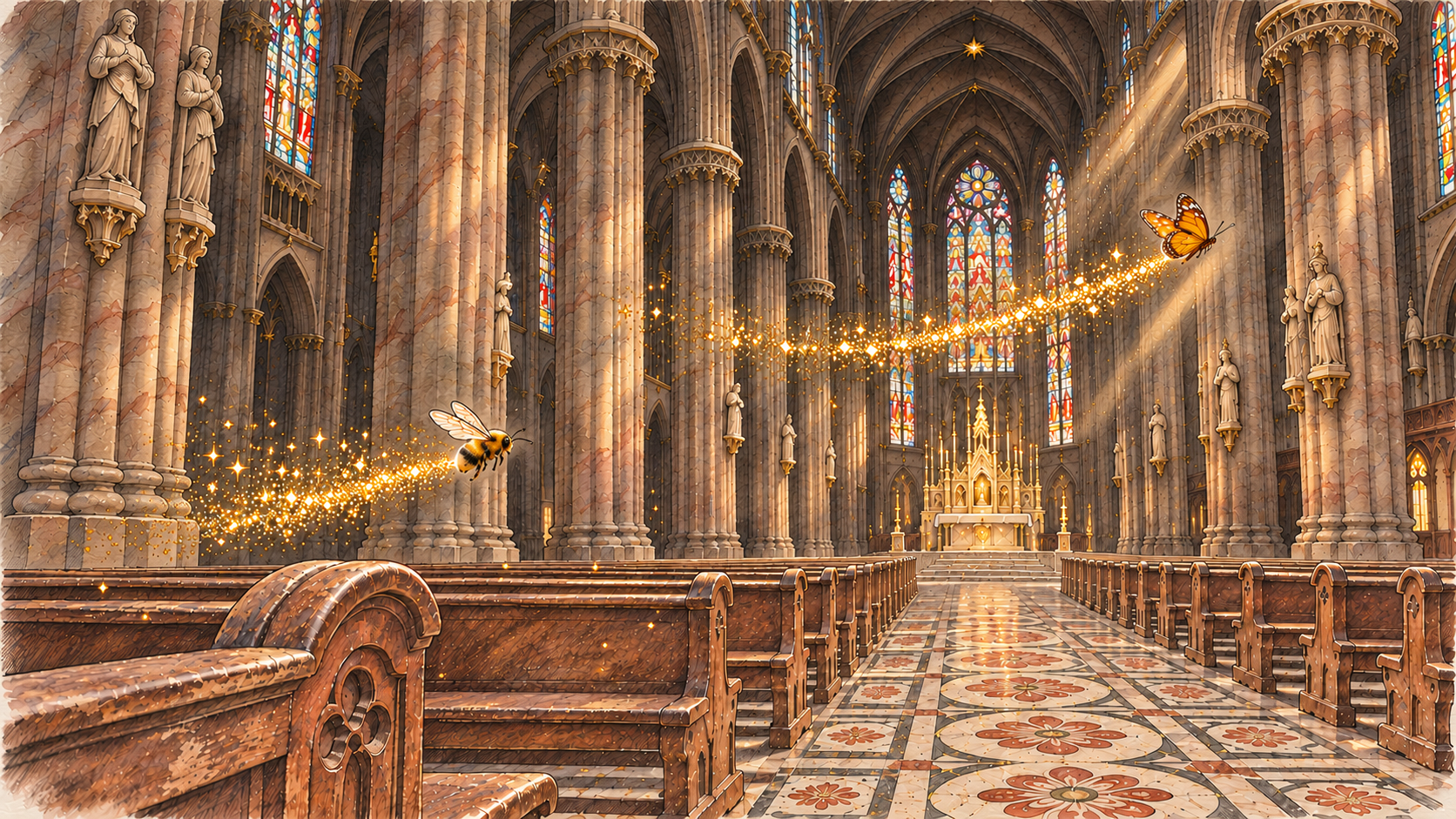
That morning, kneeling in a very old, very uncomfortable pew in Milan’s Duomo, I had asked God to show me a butterfly or a bumblebee. Then I apologized for asking. Apparently, even my prayers come with a follow-up email.
I told Him I knew He didn’t owe me a sign. I should trust Him. By now, I should have a better handle on the difference between His voice and my own thoughts, which are plentiful and rarely wait to be invited into a conversation. But I was asking anyway, hoping for reassurance that I was understanding something correctly.
That evening, a butterfly fluttered down the entire length of our dinner table. Inside a restaurant. In Milan. In November. Having requested a butterfly approximately eight hours earlier, I immediately decided that was probably a coincidence. You can see how I might be exhausting.
So when the bumblebee socks appeared on Thursday, in the middle of a meeting at Fender, I had to work to keep my face appropriate for the setting. Nobody else in the room had any reason to know what was happening in my head. To me, it felt like an affectionate eye roll from God. Amy. Are you listening?
I thought I was. What I’m beginning to wonder is whether I’ve been listening very carefully around the edges of some questions I’m afraid to ask.
The reason I was in Europe in the first place probably explains something about how my brain works. In Milan, I was supporting one of my team members through a full day with his client’s global team. In London, I was supporting another at a Fender business review, as well as running an internal workshop on how our client services and commercial teams work together. As their manager, my job was to help them succeed in those rooms, contribute where they needed me, and bring what I was seeing in the field back to my own leadership.
That means reading the room. Recognizing when someone needs support, when a question needs asking, or when two teams are describing the same problem from opposite sides. I’m listening to the conversation in front of me while connecting it to three other conversations, something that happened last month, and a problem I suspect we’ll have next quarter if nobody addresses it. There is now an actual professional reason for all those tabs to be open.
I enjoyed managing clients directly, and I was good at it. But this role makes an almost embarrassingly obvious amount of sense for the way I’m wired. I love being able to help someone walk into a meeting better prepared, get a conversation unstuck, or make it easier for two teams to do good work together. There’s something satisfying about realizing that the way your brain has always worked has a useful place to go.
I’d spent the week noticing things, making connections, and working out what they meant. You can understand why I thought I could bring the same approach to my conversations with God. Gather the information, identify the pattern, ask a few clarifying questions. Surely, at some point, the direction would become clear.
But at work, I can ask what success looks like before we start building a plan. With God, I’m beginning to suspect I’ve sometimes supplied that answer myself.
I’ll pray for wisdom, peace, and clarity. All sincere requests. But I can get through a fairly thorough conversation with Him while carefully avoiding the one thing I’m most afraid He might answer. Because what if I don’t like the answer? That’s less flattering than “I’m waiting for clarity,” but probably closer to the truth.
Understanding how things fit together makes me feel safe. If I can see the moving parts, I can prepare. I can spot what might go wrong and do something about it. It’s difficult to admit how much I want that same protection in my faith. I want to trust God, and I want enough information to make sure trusting Him won’t hurt. I don’t think there’s a spreadsheet for that.
There are things I’ve brought to Him with what I believed was an open heart, while quietly keeping certain possibilities off the table. I want His direction. I would also appreciate it if that direction led somewhere I’ve already decided I’d like to go. Ideally, He could confirm the route. A butterfly would be fine.
Somewhere in the middle of this week, I had the uncomfortable thought that perhaps all this careful wording was an attempt to guard my heart.
From God.
The absurdity was not lost on me. He presumably does not need me to finish the sentence to know what’s in it. But neither was the fear underneath it. When you’ve wanted something deeply, asking an honest question can feel like risking the answer you’ve been holding onto. Leaving it unasked gives you a little longer to live in the version of the story you understand. I don’t think I’d realized how much I was doing that.
While in London, I saw Les Misérables and Jesus Christ Superstar, which means I managed to fit a considerable amount of theology into a work trip without submitting any of it for reimbursement. I expected to enjoy the shows. I hadn’t expected them to become part of the conversation I was already having with God.
The scene with the bishop in Les Mis stayed with me. Valjean steals his silver, and when he’s brought back, the bishop tells the authorities it was a gift. Then he gives him the candlesticks, too. It’s already an extraordinary act of mercy to protect the man who has stolen from you. But to give him more? To look at someone in that moment and see a life still worth believing in?
I watch Les Mis and see the salvation of Christ running through it. Grace offered before it could possibly be earned, and a life changed by receiving it. Valjean spends the rest of the story learning to extend that mercy to others, often at great personal cost. By the time we reach the line about seeing the face of God in loving another person, we’ve watched what that love requires of him.
The bishop couldn’t have handed Valjean a detailed explanation of everything that would follow. He showed him mercy in the moment in front of him. I keep thinking about how much began there, and how little either of them could have known about where it would lead. I’m quite sure I would have wanted more information.
Jesus Christ Superstar gave me other things to consider, some of which concerned casting and a significant number of which concerned glitter. During the lashings, cast members threw fistfuls of it at Jesus, where it stuck to the blood covering him. The amount involved suggested someone had approved a budget without asking enough questions. It worked theatrically. It also left me hoping the backstage facilities included exceptionally good showers.
I’m not going to assign spiritual meaning to every piece of glitter. Even I have limits. But it was an unusual week to be thinking about how I encounter God: a cathedral people spent generations building, a story of life-changing mercy, and a portrayal of the crucifixion involving enough sparkle to permanently alter a theater’s ecosystem.
Yet the moment that brought me straight back to my own quiet prayer happened while I was supposed to be concentrating on a meeting. I looked down, saw those socks, and felt heard. I’m trying to let that matter without immediately demanding a full explanation of what comes next.
Perhaps I’ve been confusing hearing God with knowing how the story ends. I’m beginning to believe two things can be true: God can place a desire on your heart, and the outcome can still look different from the one you attached to that desire. I find that much easier to write than to accept.
If I feel called toward something, I tend to picture arriving there. Once I’ve pictured that outcome, my brain starts working backward. What needs to happen? In what order? What can I do today to move us closer? It rarely occurs to me to ask whether the destination was part of what I heard, or something I filled in myself.
I could understand the invitation and misunderstand its purpose.
Something I pursue might lead to a conversation my husband and I needed to have, reveal something we’ve been carrying, or teach us how to love each other through uncertainty we would never have volunteered for. There could be something happening between us, or within us, that I’m overlooking because I’m so focused on where I thought we were going.
I don’t want to hurry toward a tidy explanation in which every painful thing was necessary because it taught me a lesson. Finding meaning in an experience doesn’t mean I have to be grateful for every part of it. And being open to a different ending doesn’t mean I’ve stopped wanting the one I hoped for. I’m still working out how to hold both of those things.
But I can see how tightly I sometimes hold the outcome, and how much of my attention goes toward getting there. I want to make room to ask what deserves my attention now. What we might need to understand. What I’m afraid to say to Him, even though He already knows. Those questions deserve at least as much honesty as the ones I’m comfortable asking.
I’m writing this on my way home, with a suitcase full of chocolate and a few questions I wasn’t asking when I left. I like the way my brain works. This week reminded me how much good I can do with it, and how satisfying it is to help my team do work they’re proud of. I’m also beginning to see how quickly I can turn an invitation to trust into an assignment to figure everything out.
I believe God was speaking to me through that butterfly and those bumblebees. But I’ve been trying to make the reassurance do more than it necessarily meant to. Feeling heard doesn’t mean every hope I carried into that cathedral has been confirmed. I can believe He put something on my heart and still have more to learn about why.
That’s the conversation I need to have with Him. The one where I stop carefully phrasing my questions to leave room for only the answers I want. Where I can admit how much something matters to me, how afraid I am of being disappointed, and how little I understand about where we’re going. He already knows all of that. I’m the one who’s been trying to get through the meeting without putting it on the agenda.
I don’t expect to stop making plans or asking follow-up questions. But I want to ask what He’s inviting me to notice, to learn, and to do now, even while the outcome remains uncertain. I want to leave room for an answer I haven’t already written.
I asked for a butterfly or a bumblebee. I got both, and I still don’t have a project plan.
I do think it’s time to ask the real question.