The Words We Keep

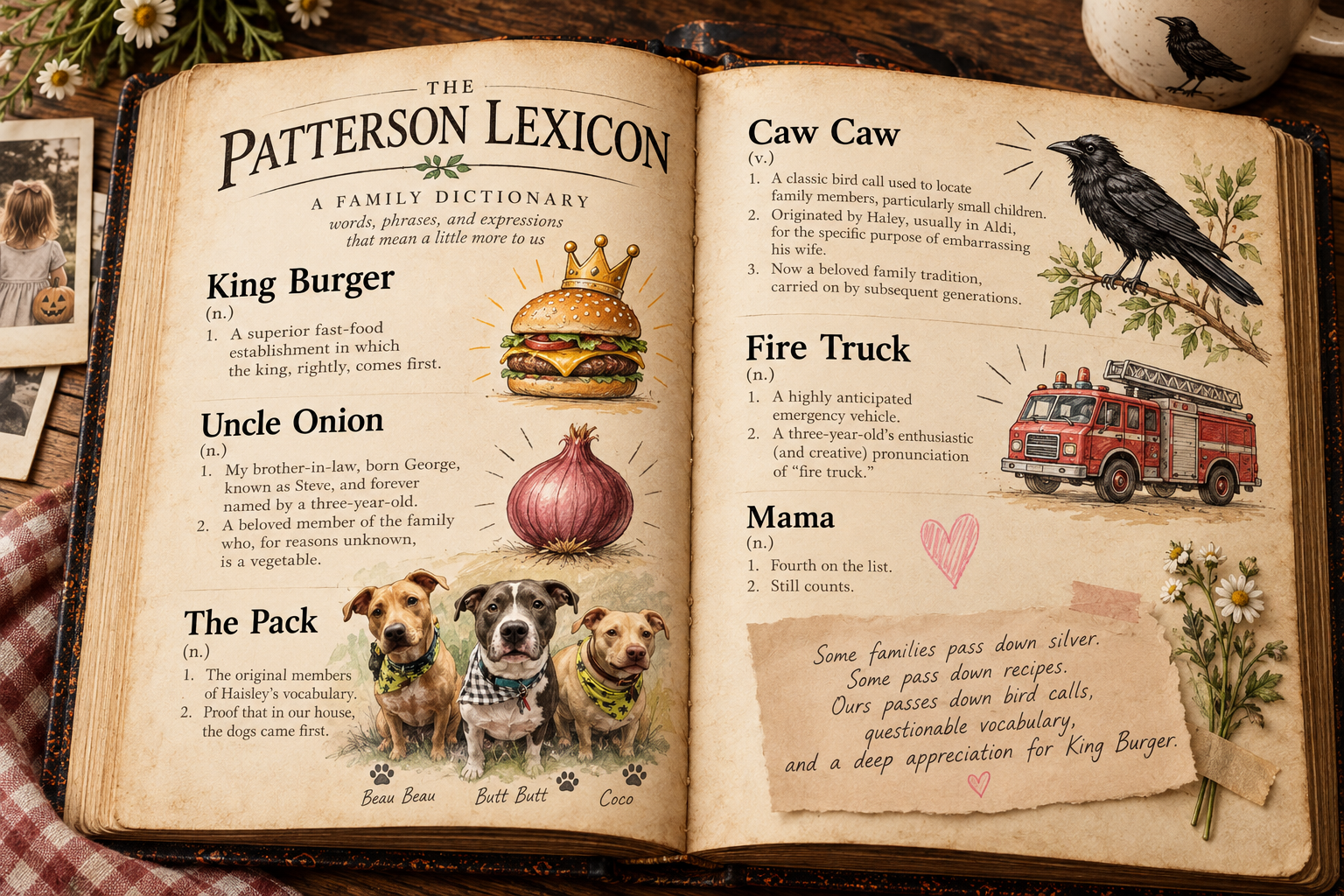
We were driving home from a community trunk-or-treat event the other night, having the kind of conversation that happens in just about every household with a three-year-old. It was getting late, bedtime was rapidly approaching, and Jimmy and I were trying to figure out where we could grab something quick for dinner without turning an already long evening into an even longer one. We were tossing around options when a little voice from the backseat confidently announced, “I want King Burger!”
Jimmy and I looked at each other and burst out laughing. King Burger. Not Burger King. King Burger. And honestly, when you think about it, she’s got a point. The king probably should come first.
It was such an ordinary moment, the kind that happens a hundred times a day when you’re raising a toddler, but something about it stuck with me. Our daughter had just casually renamed a multinational fast-food chain, and neither of us had any intention of correcting her. In fact, there’s a pretty good chance we’ll be calling it King Burger for the foreseeable future. Which got me thinking about the strange little language that develops inside a family, made up of words and expressions that mean absolutely nothing to the outside world but are perfectly understood by the people who share your home.
Every family has its own vocabulary. The mispronunciations that become permanent, the nicknames nobody remembers inventing, the inside jokes that stopped being particularly funny years ago but somehow never stopped being told. Sometimes they’re inherited from the generations before us, and sometimes they’re invented by a three-year-old who has apparently decided the English language could use a little improvement.
Our family has accumulated quite a collection.
When you’re expecting a baby, people love to ask whether you think their first word will be Mama or Dada. Parents make predictions, grandparents place their bets, and there’s usually at least a little friendly competition involved. In our house, neither Jimmy nor I stood a chance. Haisley’s first word was Beau Beau, the name of one of our dogs. Her second was Butt Butt, which is what she called Butters, followed by Coco for Colby. Only after she’d successfully identified the canine population did she finally get around to acknowledging the woman who had carried her for nine months, given birth to her, and tended to her every need. Mama came in fourth. Not even a podium finish.
I suppose I should be grateful I made the list at all. In fairness, our house has always been something of a zoo, so perhaps she was simply working through the roster in order of importance. Still, there’s something humbling about realizing your child learned to summon three dogs before she felt the need to address you by name.
Her creativity with language has only gotten more entertaining as she’s gotten older. My brother-in-law, for example, has two perfectly respectable names. His legal name is George, but he goes by his middle name, Steve. Haisley has rejected both options entirely and instead decided that he shall be known as Uncle Onion. I couldn’t begin to explain how she arrived at this particular designation, but at some point the three-year-old made an executive decision, and the rest of the family simply accepted it.
I’ve actually become so attached to Uncle Onion that I’m now determined to make sure Haisley doesn’t discover either of his real names until she’s at least eighteen. Imagine spending your entire childhood believing you have an Uncle Onion, only to find out at your high school graduation that the man was born George and has spent his adult life answering to Steve. That’s the kind of family secret I can enthusiastically support.
And then there’s the fire truck. Or, as Haisley once so enthusiastically called it, the “fire fuck.” Yes, you read that correctly. There’s video evidence, which I fully intend to preserve for posterity and potentially use at her wedding. I realize that as her mother I’m supposed to gently model the correct pronunciation and encourage her language development, and I do. But I’m also human, and there are only so many times a toddler can excitedly announce the arrival of a fire fuck before you have to leave the room to compose yourself.
These are the moments nobody mentions in the parenting books. You spend so much time worrying about whether your child is meeting milestones, learning appropriately, and developing the skills she’ll need to navigate the world, and then one day she calls her uncle a vegetable and you realize that some of the best parts of raising a child have absolutely nothing to do with the milestones you’re tracking.
Of course, not all of our family’s strange vocabulary originated with Haisley. Some of it predates her by decades, and at least one particularly ridiculous tradition can be traced directly to my late father-in-law, Harley.
If you happen to be visiting our house and hear someone loudly yell “CAW CAW!” from another room, please don’t be alarmed. We do not have a bird loose in the house, although given the number of animals we already have, I suppose it’s not entirely outside the realm of possibility. It’s simply how we locate our daughter. Someone shouts “CAW CAW!” and Haisley is expected to respond with a matching call so we know where she is. It’s surprisingly effective, and she seems to find the whole arrangement perfectly reasonable.
The origin of this particular communication system is considerably less practical. Jimmy’s dad used to wander through Aldi making the same ridiculous bird call, specifically to embarrass Jimmy’s mom. Not because anyone was lost or needed to be found, but because apparently Harley considered the middle of a grocery store an excellent place to impersonate a large bird at his wife’s expense. For anyone unfamiliar with Aldi’s infamous aisle of shame, it’s that magical stretch of the store where you go in for milk and somehow emerge with a patio umbrella, a cordless drill, and a seasonal wreath you didn’t know you needed. Apparently, Harley found it an ideal setting for a little public humiliation.
I wish I could tell you there was some deeper significance to the original tradition, but as far as I know, there wasn’t. He thought it was funny, Jimmy’s mom was appropriately mortified, and the rest of the family apparently found the whole thing entertaining enough to keep it alive. And now, years later, his granddaughter is running around our house answering those same bird calls as though this is a perfectly normal way for human beings to communicate.
Harley passed away in July of 2024, when Haisley was barely a year old. She won’t have the opportunity to grow up knowing him the way Jimmy did, and there are so many things about him that she’ll have to learn through photographs and stories. But every once in a while, I catch myself thinking about the little ways he’s still present in our lives, often when I’m least expecting it. Like when Jimmy hollers “CAW CAW!” down the hallway and a tiny voice answers from somewhere behind the couch.
It’s such a ridiculous thing, and yet there’s something rather wonderful about the fact that a joke Harley started for the sole purpose of embarrassing his wife has become part of the everyday language of a granddaughter who won’t remember him. He couldn’t possibly have imagined that his nonsense would eventually become a family tradition, but I suspect he’d be absolutely delighted. Especially knowing that he’s still managing to embarrass people.
I’ve been thinking about how much of family life is built this way. We tend to imagine traditions as intentional things: recipes passed down through generations, Christmas ornaments carefully wrapped and stored, special birthday breakfasts, holiday gatherings, and stories we make a point of retelling so nobody forgets. Those things matter, of course, but there’s another kind of inheritance that happens almost entirely by accident. It’s the phrase your mother always said that you swore you’d never repeat, until one day you hear it coming out of your own mouth. It’s the nickname that made sense exactly once, twenty years ago, and somehow followed someone into middle age. It’s the joke nobody remembers starting, or the word everyone in your family pronounces incorrectly even though you all know perfectly well how it’s supposed to be said.
Nobody formally decides to pass these things along. They rarely get written down, and they certainly don’t feel important enough to preserve while they’re happening. They just become part of the way we talk, so familiar that we hardly notice them anymore. But over time, they form a kind of shared language, one that carries little pieces of our history without requiring us to stop and explain where everything came from.
I think there’s something especially interesting about the way children contribute to that language. When Haisley was born, she entered a family that already had its own stories, habits, jokes, and expressions. There were things Jimmy brought from his childhood, things I brought from mine, and things we’d created together over the course of our marriage. She inherited all of it without having any idea where most of it originated, and now she’s adding her own contributions. King Burger. Uncle Onion. Fire fuck. Because we love her, and because these things make us laugh, and because there’s something irresistible about the way a little person makes sense of the world, we adopt them without a second thought.
We spend so much of our time as parents teaching our children how to communicate. We repeat words, correct pronunciation, explain meanings, and patiently answer approximately seventeen thousand questions a day. But somewhere along the way, they start teaching us a new language, too. And before we know it, we’re using their words in conversations where they aren’t even present. Jimmy and I can talk about King Burger without Haisley anywhere nearby, and neither of us has to explain what we mean. Uncle Onion is Uncle Onion. The bird calls are an accepted household practice. These things have become ours, even though most of them started with her.
I know there will come a day when Haisley stops saying these things. She’ll learn that the restaurant is called Burger King, she’ll master the pronunciation of fire truck, and she’ll probably discover that her uncle’s name is not, in fact, a vegetable. Although, if I have anything to say about it, that last revelation is at least fifteen years away. Her vocabulary will expand, the little quirks of toddlerhood will gradually disappear, and she’ll develop the language of a bigger kid, then a teenager, and eventually an adult.
And that’s exactly what’s supposed to happen. I’m not particularly interested in wishing away the years or mourning every milestone before it arrives. I love watching her grow, and I genuinely enjoy discovering more of the person she’s becoming. But I also like knowing that we don’t have to let every little thing disappear just because she’s outgrown it. We can keep calling it King Burger. We can keep calling Steve Uncle Onion. We can keep embarrassing one another with bird calls long after she’s old enough to roll her eyes at us for doing it.
Maybe someday Haisley will have a family of her own, and she’ll find herself standing in the kitchen shouting “CAW CAW!” down the hallway without giving it a second thought. Maybe her children will answer, or maybe they’ll ask why on earth their mother is making bird noises in the house. And maybe she’ll tell them about her dad, and his dad, and a man named Harley who once made an absolute spectacle of himself in the middle of Aldi because he thought embarrassing his wife was a perfectly reasonable way to spend an afternoon.
Or maybe she won’t even remember where it started. Maybe it’ll just be something her family does, another ridiculous little piece of language that gets carried into a new generation without anyone making a conscious decision to preserve it.
I think I’d be okay with that, too. Because not everything meaningful has to be solemn, not every family heirloom fits in a jewelry box, and not every legacy begins with someone trying to leave one. Sometimes the things that last are simply the things that made us laugh.
Some families pass down silver. Some pass down recipes. Apparently, ours passes down bird calls, questionable vocabulary, and a deep appreciation for King Burger.
And somewhere, I hope Harley is getting a good laugh out of the whole thing.
CAW CAW 🤍