The Unpaid Labor of Sounding Reasonable

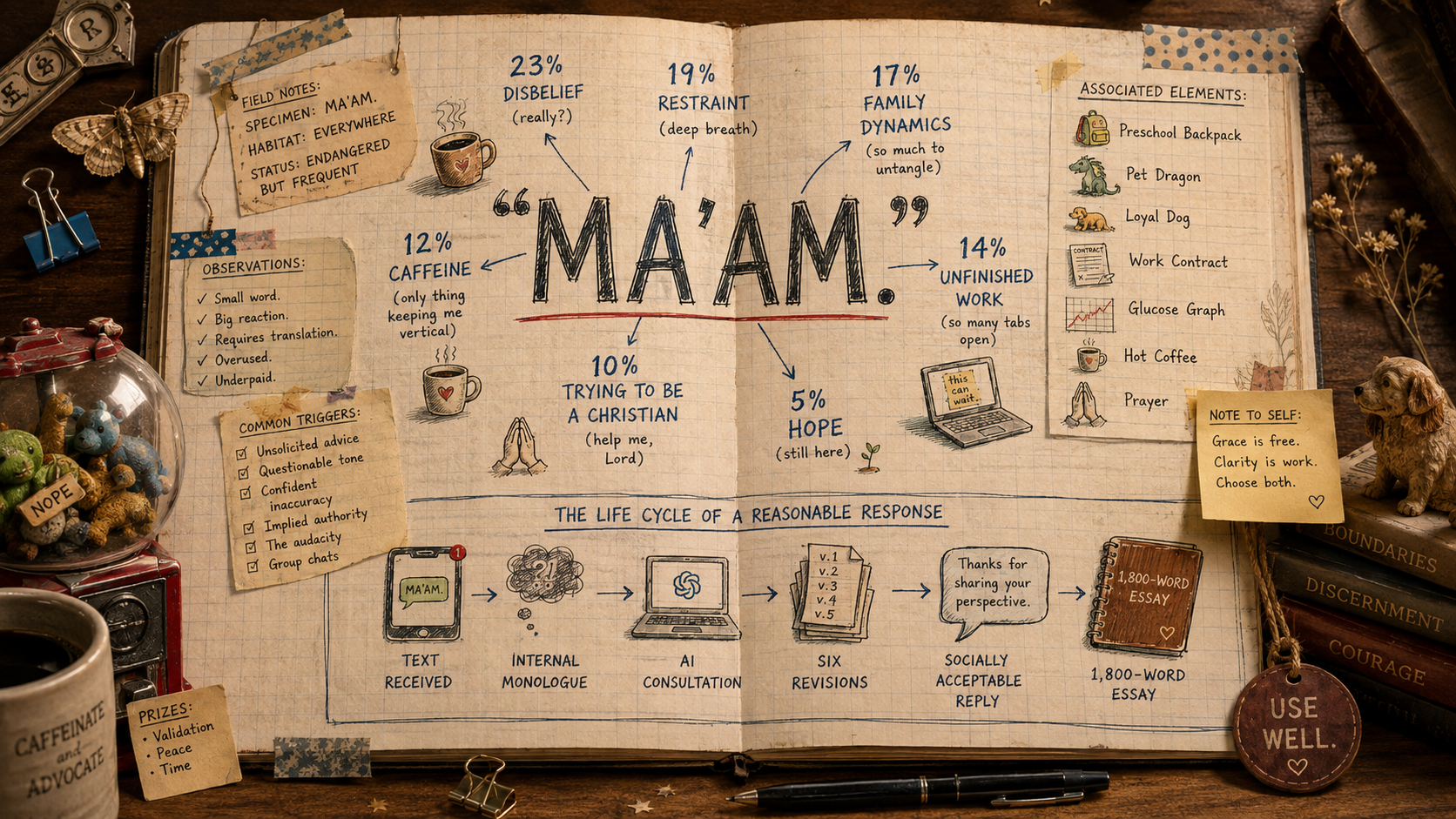
No, I have not given up writing my blog.
“Have you given up writing your blog?” my mother texted me at 9:05 on a Tuesday night.
Ma’am.
I have a demanding executive-level job, a three-year-old starting preschool, a husband, approximately 47 animals, and a body requiring its own full-time administrative department in the form of an insulin pump. Forgive me for failing to maintain a rigorous publishing schedule for my unpaid personal blog.
Of course, that is not what I said.
What I said was:
“No, I’m just really super busy.”
Followed by:
“I’m still working right now.”
I will pause here so we can all admire my restraint.
To be fair, my mother probably believed she was asking a perfectly reasonable question. My brain simply received it as an allegation.
Have you given up?
Given up. As if I had dramatically thrown my laptop into a lake, renounced the written word, and accepted that I would never again burden the internet with 1,500 words about a tree that looked like a Toy Story alien.
This is how my mind works. There is the question someone actually asks, the response that immediately appears in my head, and the response I eventually allow another human being to receive.
There are, essentially, two versions of me.
The first is fast, specific, heavily caffeinated, and rarely burdened by the possible consequences of her words. She is passionate, profane, occasionally disproportionate, and often very funny. At least to herself.
Then there is the version of me who actually communicates with other human beings. She takes the first response, removes several curse words, softens the opening, adds context nobody requested, considers how every person involved might feel, rereads it six times, and ultimately sends something so restrained that it barely qualifies as having a personality.
That process takes time.
In my professional life, we would call it LOE: level of effort. And the LOE required to turn my actual internal monologue into something suitable for public consumption is, frankly, substantial.
This is also why I have not written a blog post lately.
It is not because I have nothing to say. I have never, in the history of my life, suffered from having nothing to say.
It is because writing the way I actually think would be quick. Writing the way I want to be understood takes considerably longer.
Every essay begins in my native language: passionate, profane, overly detailed, mildly unhinged, and occasionally funny enough to jeopardize an otherwise stable relationship. Then comes the translation.
I remove the names of people who will absolutely recognize themselves anyway, except in this essay, apparently, where I identified my mother in the opening sentence and included a timestamp. I cut the three paragraphs of background information I believe are necessary to understand why I am objectively correct. I reconsider the sentence that made me laugh the hardest because it may also cause a small regional incident. I add grace. I look for the part where the story is about something larger than the fact that another person has annoyed me.
That does not make the final version less honest. The first reaction may be true, but it is rarely the whole truth. The essay is where I sit with it long enough to discover what else is true.
Grace is not dishonesty. Grace is a second draft.
But second drafts take time.
According to My Chat History, I Have Not Shut Up
If anyone requires evidence that I have not suddenly stopped writing, I would like to submit my artificial intelligence chat history.
Out of curiosity, I asked my AI how much we had discussed since I published my last blog, The Playground Is Harder Than the Boardroom, on July 14.
Its conservative count was at least 38 separate conversation threads, nearly 40 primary topics, and well over 100 individual questions, follow-ups, revisions, and minor emotional emergencies in 29 days.
In that time, I have asked it about multimillion-dollar contracts, client churn, leadership transitions, carb counts, ovarian cysts, pool chlorine, toddler underwear, pork tenderloin, a pupating hornworm, and how to transform my husband into a wearable version of the claw from Toy Story for Halloween.
I asked it to identify a 1955 Ford Jimmy spotted, determine whether Walmart’s “tip-free delivery” was secretly a scam, help me feed a preschool bearded dragon named Zeke, estimate the carbohydrates in lobster bisque, and decide whether a cauliflower-crust Hawaiian pizza required an amount of insulin best described as “some” or “dear God.”
I have used it to plan Disney trips we could barely justify, reconsider Disney trips we absolutely could not justify, assemble school lunches for a child who survives primarily on chicken nuggets and audacity, and brainstorm memes about how two exhausted older parents are supposed to make a second baby when the first one refuses to go to sleep.
I have also asked it to rewrite approximately 900 professional emails whose original thesis was, “What the actual fuck is happening?” but whose final thesis needed to be, “Thank you so much for the additional context. I’d love to ensure we’re aligned on next steps.”
Somewhere along the way, my AI became part copy editor, part chief of staff, part carb calculator, part fertility translator, part costume designer, and part witness to the sheer number of browser tabs currently open inside my brain.
So no, I have not stopped writing.
If anything, I have created enough written material to support an independent data center. I just have not turned much of it into an essay.
The Things I Was Not Ready to Write Yet
Some of those conversations have been funny. Some have been practical. Some have helped me find words for things I was not ready to say publicly.
One of those things is that Jimmy and I are receiving fertility treatments.
We have now shared that with our families, which means I finally feel ready to share it here too.
This is not a pregnancy announcement. We do not know how the story ends. We simply know that we would love to have another child, that getting there will require some help, and that we have decided to try.
We conceived Haisley naturally when I was 38, and I delivered her at 39. It is tempting to believe that because my body did it once, it can simply do it again. But fertility is not sentimental, and four years can change the equation considerably.
At 42, my age is our biggest obstacle. My AMH, one of the numbers doctors use to estimate ovarian reserve, was 0.71, which our doctor called above average for my age. My baseline ultrasound showed nine follicles, another encouraging result in a process that does not offer many of them. But neither number can undo what age means for egg quality.
Based on my age and overall clinical picture, our doctor recommended three medicated IUI cycles using Clomid and estimated that each one gives us roughly a 5% chance of a live birth. Yes, you read that correctly. A. Five. Percent. Chance.
Five percent is humbling. On paper, it also means a 95% chance that any individual attempt will not work. It is enough to make hope feel almost audacious.
We are not treating faith like a contract. We know prayer does not obligate God to give us the ending we want. But we also know that five percent is not zero, and we firmly believe God can still do a lot with five percent.
We are already parents to the funniest, sweetest, most observant three-year-old girl in the world. We know exactly how blessed we are to have Haisley. Wanting another child does not diminish that gratitude, just as gratitude does not erase the longing for someone who might still be missing from our family.
We are also older parents. We understand the realities, the statistics, and, perhaps most urgently, the fact that we are already extremely tired. There is nothing especially romantic about trying to create a baby after spending the day negotiating with a three-year-old about, well, everything.
Still, we are choosing to try.
Fertility treatment has added appointments, bloodwork, calendars, phone calls, waiting, expense, disappointment, and an impressive number of acronyms to a life that was not exactly suffering from a lack of logistics.
My AI has been part of those conversations too. It has helped me calculate dates, understand test results, organize questions for doctors, decipher conflicting instructions, and talk myself down when a single line in a patient portal felt like it had the power to determine our entire future.
There are many questions it can help me answer.
It cannot tell me how this story ends.
That part requires something other than information. It requires hope, patience, faith, and a willingness to live inside a question that may not resolve the way we want it to.
Now that the people closest to us know, we are also asking for prayer. We will take every single one we can get.
Pray for wisdom as we make decisions. Pray for peace while we wait. Pray for my health, for Jimmy, for our marriage, and for Haisley as we navigate whatever comes next. And, if it is God’s will, pray that there is another little person meant to join our family.
We are hopeful. We are realistic. Most days, we are both at the same time.
Writing From the Middle
Maybe that is the real reason I have not written lately.
Some stories are easy to tell once they are over. You can arrange the events neatly. You can identify the lesson. You can decide which moments were foreshadowing and which were simply terrible Tuesdays.
It is harder to write from the middle, before you know whether you are documenting a beginning, an ending, or simply a season of learning how little control you actually have.
Right now, much of my life is still in the middle.
As I write this, Haisley is about to start PK3. My career is stretching and shifting in ways that are exciting, exhausting, and occasionally absurd. My body demands daily calculations and constant attention. Our family is reaching toward something we deeply want without knowing whether we will be able to hold it.
Meanwhile, the dogs need to go out, the dragon needs vegetables, someone needs to shock the pool, and a client would like to know whether I have 30 minutes tomorrow to “quickly align.”
I am not short on material. I am standing in the middle of too much of it.
Writing asks me to stop long enough to notice what a moment meant. Life has not been especially interested in stopping lately.
So no, Mom. I have not given up writing my blog.
I am still writing. I am still noticing. I am still collecting sentences between meetings, preschool forms, doctor appointments, carb calculations, and conversations about whether a grown man can reasonably be turned into an arcade claw using PVC pipe.
I am simply in the extremely labor-intensive process of turning “Ma’am.” into an essay.