The Traditions We Choose

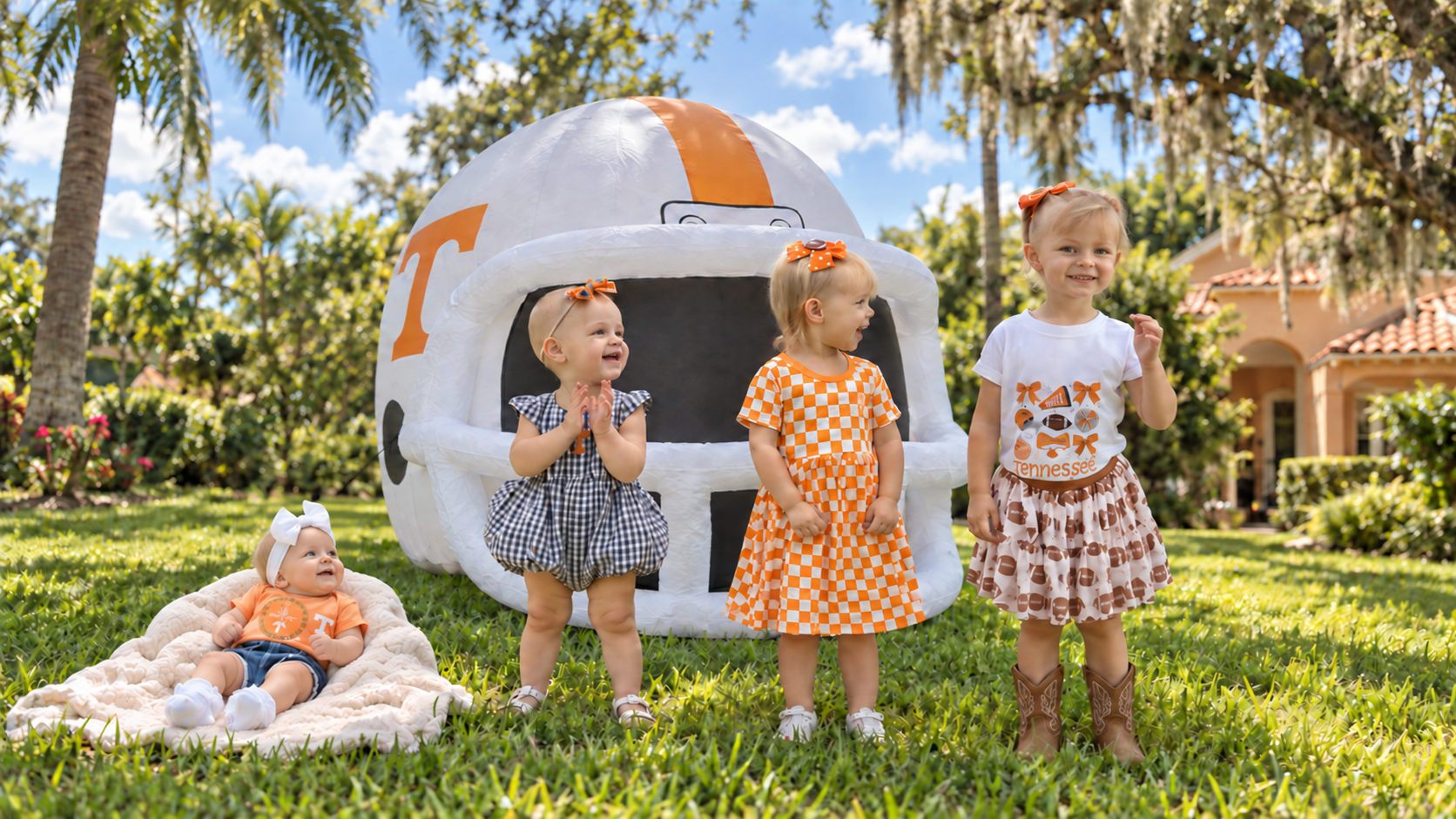
Every September, Jimmy drags a giant inflatable Tennessee football helmet into our front yard in Lakeland, Florida, which is exactly as subtle as it sounds.
The first year, Haisley was three months old. Jimmy stood beside the helmet holding this tiny, wide-eyed baby dressed in orange, both of them looking like they had been assigned very different levels of responsibility for the upcoming football season. The next year, she stood inside it and gave him a high five. Last year, she was a little taller, a little steadier, and already very sure that Daddy’s team was her team.
This year, she climbed into the helmet in her Tennessee skirt and held his hand while I took the picture.
Four years. One helmet. A whole lot of Rocky Top spirit thriving deep in enemy territory.
It started as a photo. Somewhere along the way, it became a tradition.
That is the funny thing about family traditions. We tend to imagine them arriving fully formed, handed down through generations along with the good silver and a recipe nobody is allowed to alter. But sometimes a tradition begins with no ceremony at all. You do something once because it feels fun. You do it again because you remember. By the third year, everyone knows the assignment.
And suddenly, this is what your family does.
Some of our traditions came to us long before Haisley did. Tennessee football belongs to Jimmy’s childhood, his home state, and his family. He was born and raised in Tennessee, and being a Volunteer is less a sports preference than an inherited condition. It is orange shirts, familiar songs, Saturdays organized around kickoff, and an entirely unreasonable emotional investment in what a group of college students does with a football.
It is also tangled up with his dad.
Harley loved Tennessee football. Watching it together was one of those ordinary father-and-son rituals that probably did not announce itself as sacred while it was happening. Most sacred things do not. They look like sitting in the same room, wearing the same color, complaining about the same play call, year after year.
Haisley will not get to grow up watching Tennessee games with her Papa the way Jimmy did. That is one of the quiet cruelties of grief: you do not only lose what was. You lose what should have been.
But she carries his name. She carries pieces of the family he helped build. And every year when Jimmy kneels beside that ridiculous inflatable helmet, another small piece of what Harley gave him is passed forward to her.
Tradition cannot replace a person. It can, however, keep love moving.
Faith and music came to us much the same way. Jimmy grew up Methodist, the son of a choir director, in a family where everyone sang. Now Jimmy and I sing on the worship team and Jimmy sometimes also runs sound. Haisley goes to Sunday school, knows worship music, and has already announced from the middle of perfectly ordinary family life that she wants to go to church, sing with Jesus, and worship.
There are hymns she will know because we knew them first. There are words she will hear so often that she may not realize until she is older that they were shaping her: grace, mercy, presence, home. We are not recreating either of our childhoods exactly. We could not if we tried. But we are choosing what was good, carrying it with us, and teaching it a new way to live in our home.
From my childhood, Christmas tastes like Italian knot cookies. Making them is one of those traditions that lives less in an object than in the doing: the familiar recipe, the work of shaping each cookie, and the knowledge that this is what our family makes at Christmas because it is what our family has always made at Christmas.
Now Haisley gets to grow up with them too. She did not live the Christmases I remember, but when we make the same cookies, those memories get a place at her table.
Then there is the angel stocking. It was mine when I was a little girl, and every Christmas there would be a piece of real jewelry inside it. Not another plastic trinket destined for the bottom of a toy bin, but something chosen to last.
My mom saved that stocking for Haisley. Of all the things passed between generations, there is something especially tender about seeing an object from my own childhood waiting to become part of hers.
Maybe that is the clearest picture of inheritance: my mother kept an angel safe for a granddaughter who did not exist yet. Now I get to fill it with the same kind of care.
My wedding gown has become a tradition too.
Every year, we pull it out and photograph Haisley in it. The dress that marked the beginning of our marriage now gives us a way to watch the little girl who came from that marriage grow. The gown stays the same while she changes, taking up a little more space inside it with every photograph.
There is something almost unbearably sentimental about placing her in the dress I wore while promising Jimmy we would build a life together. She is part of the life we built.
One day, those photographs will form their own kind of time capsule: the same gown, the same little girl, and year after year of becoming.
Then there are the traditions that belong only to the three of us.
Disney weekends with a different princess dress for every day. Estate-sale treasure hunting. Farmers markets. Church on Sundays, even when getting everyone dressed and out the door feels like a minor biblical trial. Birthday themes that begin as an idea and become a level of production nobody technically authorized. An annual photograph in front of a giant football helmet because Daddy is from Tennessee, Mommy owns a camera, and apparently this is who we are now.
Not all of them will last. Haisley will outgrow some things. We will forget to repeat others. Life will get busy, schedules will change, and one year she may decide she absolutely will not wear the orange outfit I lovingly selected. Given that she is three, that year could be next year.
But I am learning that the point of tradition is not perfect repetition. It is recognition.
It is the feeling of we have been here before. It is a child knowing what comes next. It is creating small landmarks in a life that otherwise moves much too quickly. Traditions tell us where we come from, but they also tell us who we are becoming together.
Before Haisley, I thought family traditions were mostly about holidays: the foods you make, the decorations you unpack, the things you do because your parents did them. Now I think they are anything repeated with enough love that they begin to hold memory.
Some come from our childhoods. Some are born in hers.
Some connect her to people she will know mostly through our stories. Others will someday become the stories she tells about us.
Maybe years from now she will roll her eyes when we inflate the helmet. Maybe she will humor us for one picture before running off to whatever matters more at fifteen. Maybe one day she will show the photos to her own family and laugh at the progression: the baby in Daddy’s arms, the toddler reaching for his hand, the little girl standing confidently inside the helmet as if it had always belonged to her.
In a way, it has.
We inherited the orange. We created the picture. Repeating it turned both into hers.
That is how a family culture is built, I think. Not all at once, and not only through the grand things. We take what formed us, keep what still feels true, and make room for something new.
Then we do it again next year.