The Preschool Plague Has Arrived

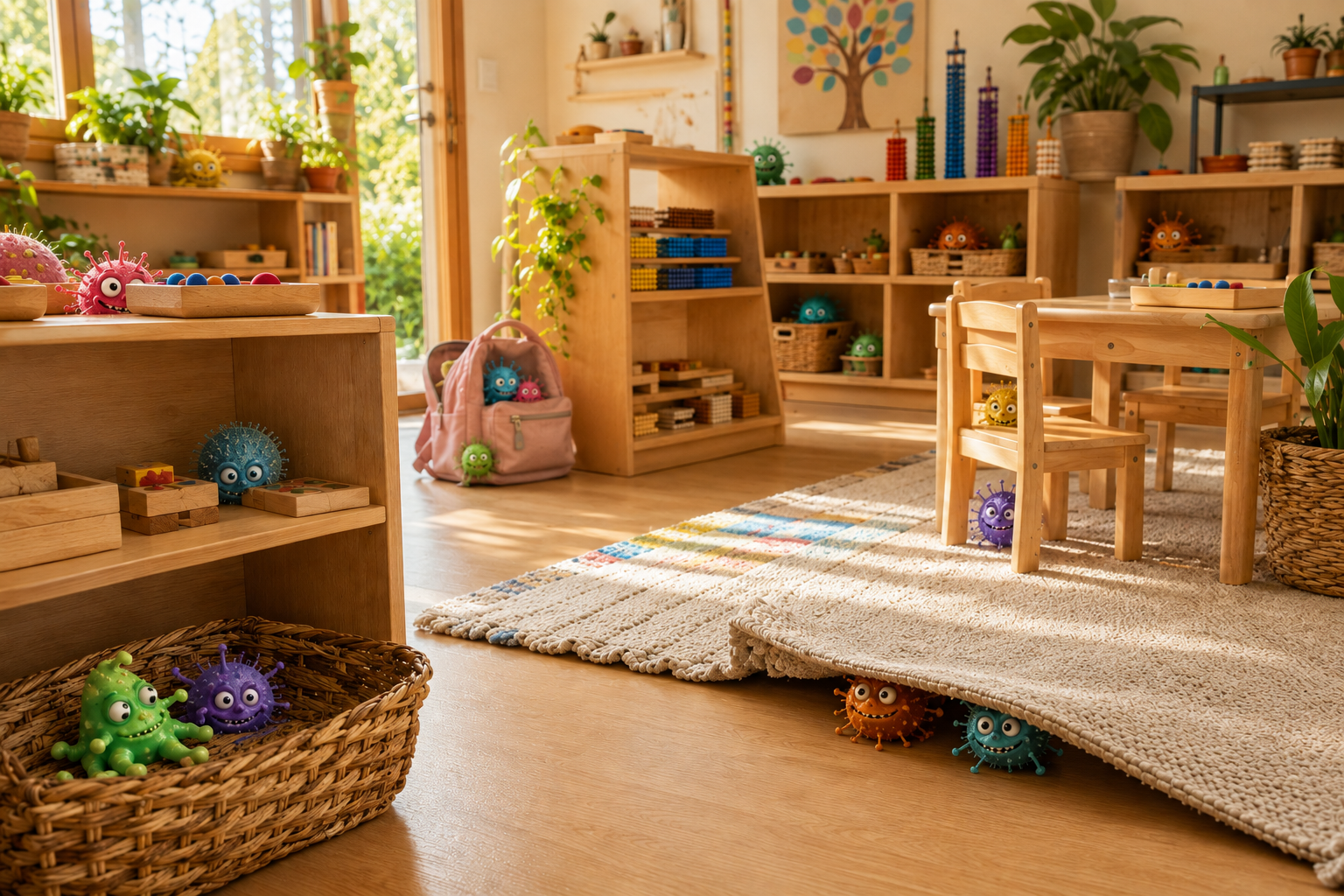
It is Monday morning, and Haisley is not at preschool.
She is at the pediatrician with Jimmy while I sit at my desk and work. Her triumphant return to PK3 has been postponed.
She made it through approximately one week before bringing home her first preschool plague.
Honestly, that feels efficient.
There are several things people warn you about before your child starts preschool. They warn you that she might cry at drop-off. That she may suddenly become clingier at home. That she’ll come back using phrases you have never said, asking for snacks you have never purchased, and passionately correcting the way you sing songs you have known since before she was born.
What they do not adequately explain is that your child will also become a tiny, tuition-funded disease courier.
It began with a little congestion, which is how all stories involving toddlers and infectious disease begin. Just enough snot to make us suspicious, but not enough to immediately derail the entire household. We entered the familiar parental negotiation phase: Is she actually sick? Is this allergies? Is she tired? Is she acting like this because she is three? Is there any scientifically reliable way to distinguish illness from her regular personality?
By bedtime Thursday, the answer was clear.
She was sick.
The night was rough. By Friday morning, she was warm, miserable, and emotionally committed to remaining horizontal. Her temperature was only 99.4, which exists in the particularly annoying medical category of “not technically a fever, but please look at this child.” She had become what I can only describe as a wet noodle with opinions.
We kept her home.
This turned out to be the right decision, because the situation quickly expanded from “Haisley has a cold” into a full-scale family health crisis. Soon Jimmy was throwing up, I was trying to manage everyone while also managing my own blood sugar, and the child who allegedly felt too weak to attend preschool still possessed enough strength to reject every reasonable attempt to help her.
She did, however, accept care from several tiny, unlicensed specialists.
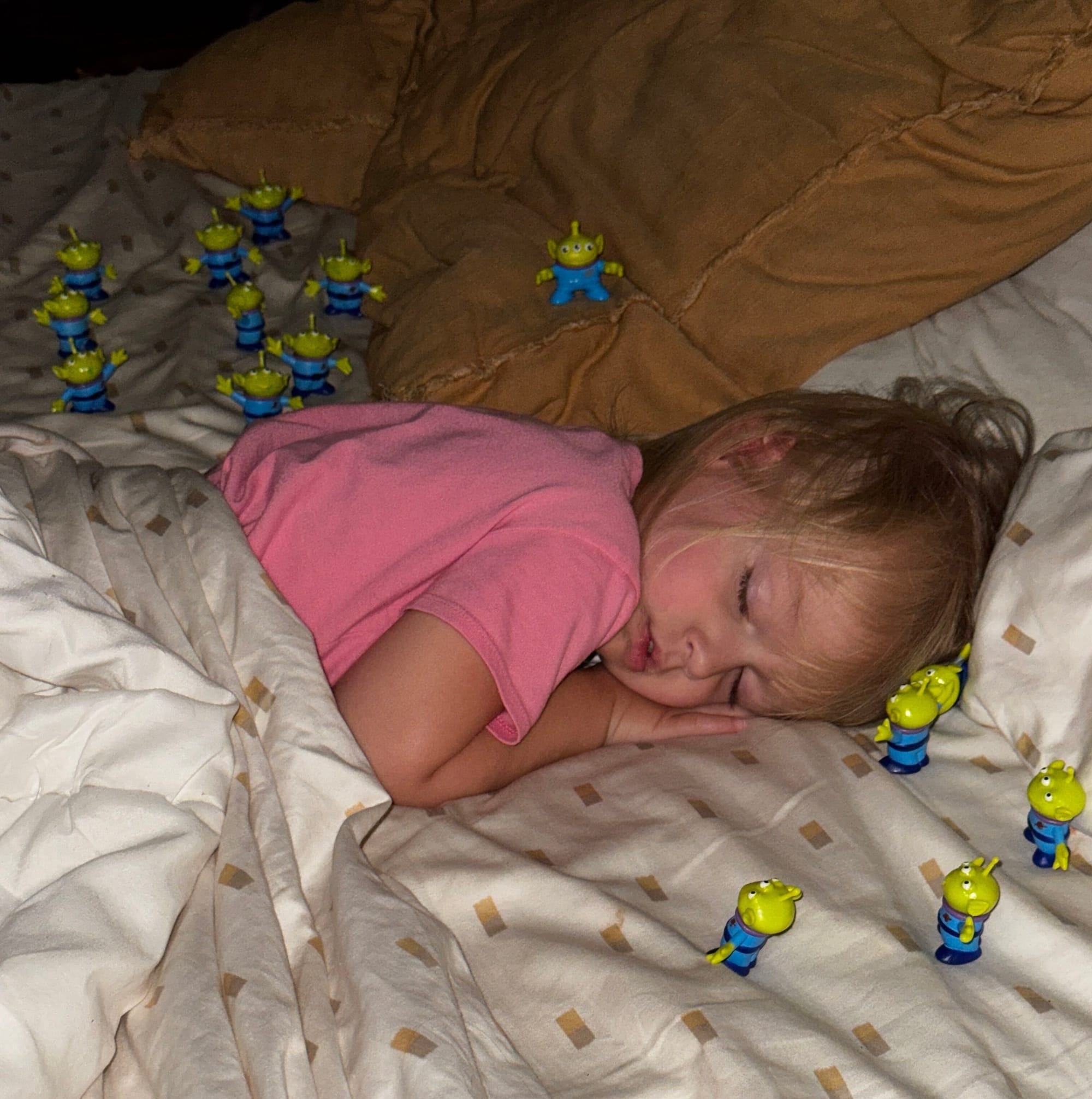
Woody was present. Buzz Lightyear was consulted. The Pizza Planet medical team monitored her closely. At various points, stuffed animals occupied more space in the bed than the actual patient. Grandpa, our 110-pound dog, joined her on the couch in a gesture of concern that somehow became physically awkward for everyone involved.
The official treatment plan included children’s medicine, snacks she requested and then refused, mosquito stickers placed directly over a mosquito bite despite our better judgment, and approximately 47 negotiations about products designed to make her feel better.
Toddlers are very particular about their healthcare.
They will scream because they feel terrible and then scream harder because you have suggested treating the thing making them feel terrible. They want comfort, but not like that. They want water, but in the other cup. They want Daddy until Daddy arrives. They want Mommy until Mommy touches them. They want to sleep in your bed, diagonally, with one damp foot pressed against your internal organs.
Because this was our first real preschool illness, we approached it with the focused anxiety of parents who are still learning the rules.
When is she too sick for school? Is 99.4 enough? Are we being responsible, or dramatic? Will she be better by Monday? Are we now the family who sends an apologetic email every six business days?
The attendance policy had already lodged itself in my brain. Ten absences. That was the number I had been given, and while I understood that attendance matters, ten days suddenly felt less like a policy and more like a countdown clock hanging over a room full of three-year-olds who lick things.
Before preschool, she was home with us. We knew where she had been, what she had touched, and which questionable object she had recently placed in her mouth.
Now she spends her mornings in a room full of other three-year-olds, a demographic not particularly known for hand hygiene or respect for personal boundaries. They share toys, stories, snacks, and apparently a rotating collection of respiratory illnesses.
This is socialization.
We wanted her to make friends. We wanted her to gain independence. We wanted her world to grow beyond our house and the small orbit of people who already adore her.
It is growing.
Unfortunately, so is her immune system.
There is something strangely humbling about watching your competent adult life collapse under the weight of one preschool cold. I can manage millions of dollars in business, navigate complicated client negotiations, adjust an insulin pump, lead meetings, coordinate doctor appointments, and keep an unreasonable number of animals alive.
Then a three-year-old produces a continuous stream of mucus, and suddenly our entire household is operating under emergency protocols.
Nobody has slept. Everybody smells vaguely medicinal. The couch is covered in blankets, cups, tissues, toys, and at least one item no one remembers bringing into the room. I have answered work messages while assessing symptoms, calculating carbohydrates, locating the correct stuffed animal, and listening to a grown man vomit elsewhere in the house.
This is not balance.
This is triage with Wi-Fi.
Monday began before 7 a.m. with Haisley inconsolably demanding a bath. At 6:57, I was drying her hair when Jimmy came into the bathroom and told me Brad was dead.
Brad was not a carnival goldfish we had forgotten to feed. He was a rare, very expensive flowerhorn Jimmy bought me as my “push present” after Haisley was born. We brought him home a few months later, which meant he had been part of our house for almost exactly three years and was permanently connected in my mind to the beginning of her life.
I had slept on the couch the night before so Haisley could spread out and be comfortable in our bed. The couch sits right beside Brad’s tank, which meant my exhausted brain immediately found another reason to feel guilty. Had he died while I was sleeping a few feet away? How had I not noticed?
I know that isn’t fair. Fish die quietly, and there was likely nothing I could have done. If that was when it happened, I was at least right beside him. But exhaustion has a way of turning every sad thing into evidence that you have failed someone.
Something in me gave way. I called my mom and lost it. I told her I couldn’t do this. I couldn’t handle one more thing. I just needed help.
She was at our house within 15 minutes.
Brad was a real loss, but his death was also one more thing added to a plate that was already dangerously overfilled. One more creature to grieve. One more problem to investigate. One more sad thing requiring feelings I did not have time to feel because I still had work to do, a sick child lying in my bed, and an entire week waiting for me.
A little later, Jimmy took Haisley to the pediatrician while I stayed home to work. The preschool cold had become an ear infection, so her triumphant return to PK3 was postponed in favor of antibiotics and continued service as a miserable wet noodle.
I had also been supposed to meet another class mom after car line that morning. She had some baby items for me to pass along to a friend who is due in a few weeks. When I told her Haisley was still home sick, I admitted that the attendance policy was quietly stressing me out.
She immediately reassured me.
PreK3 is different. The school knows the little ones get sick constantly. If Haisley has a fever, there is no reason to send her. Don’t worry about it.
It was a small exchange, but I felt my entire body exhale.
In my last post, I wrote about how badly I wanted a village and how hard it can be to find your place inside one. Maybe this is how it begins. Not with instant best friends or perfectly coordinated playdates, but with your mother arriving 15 minutes after you finally admit you cannot carry everything alone. With another mom entrusting you with baby items for a friend she has never met and calmly reminding you that keeping your sick child home will not destroy her academic career.
A village does not necessarily empty the plate.
Sometimes it comes through the door when your hands are shaking and helps you hold it.
Somewhere beneath the exhaustion, antibiotics, bodily fluids, and grief over a fish I did not expect to cry this hard about, I know this is part of the life we asked for.
Not the germs specifically. I would like to be very clear with God and the preschool administration that the germs were not included in my prayer request.
But this noisy, inconvenient, deeply interconnected little life was.
The child in my bed refusing medicine was. The husband taking her to the pediatrician while I worked was. The mother who came the moment I said I needed her was. The giant dog hovering nearby because his girl didn’t feel well was. Even the class mom who barely knows me but somehow knew exactly what I needed to hear was.
The germs may have been the first tiny hitchhikers Haisley brought home from preschool, but they were not the only thing that came with her new community.