Our Household Finances Were Running on Vibes


I've been trying to get our household finances organized for years. Not in the sense that we didn't pay our bills or had no idea what our financial obligations were. I've built budgets before. More than once, actually. I knew what our mortgage cost, what we owed on the car, roughly what our utilities ran, and which recurring commitments were going to show up every month whether I liked it or not.
What I couldn't always tell you was where the rest of the money actually went.
Which is a particularly ridiculous admission coming from someone who spends her professional life forecasting revenue, negotiating complex commercial agreements, and analyzing financial performance. At work, I'm accustomed to asking detailed questions about profitability, efficiency, and return on investment. I can spend an entire afternoon debating the financial implications of a commercial agreement without batting an eye. At home, however, our financial management strategy was considerably less sophisticated. We were operating largely on vibes. And the occasional prayer.
The thing is, I'd been on this merry-go-round before. Every so often, I'd get frustrated enough to sit down, build a spreadsheet, map out our fixed expenses, calculate what should be left over, and feel reasonably confident that I had a handle on things. Then real life would happen. Groceries, gas, a haircut, dinner because nobody had the energy to cook, something for our daughter, something for the house, and a subscription I'd forgotten existed. Individually, none of these expenses seemed particularly consequential. Collectively, they had an impressive ability to make money disappear.
And inevitably, I'd find myself wondering how the math had stopped mathing.
Looking back, I can see the flaw in my approach. I was building budgets around what I expected to happen without developing a reliable way to understand what was actually happening. I knew our fixed commitments, but I wasn't consistently examining the hundreds of smaller decisions happening between paychecks. And while I certainly had the ability to do that analysis, I didn't have the time or mental capacity to maintain it alongside everything else.
Which is particularly ironic when I consider how I approach financial performance professionally. At work, we don't wait until the end of a quarter to discover whether we're on track. We forecast, identify risks, examine variances, and adjust our approach while there's still time to influence the outcome. At home, I was essentially building a budget, living our lives, and then conducting a postmortem when the numbers didn't cooperate.
Apparently, the household CFO had been operating without a forecasting department.
But one of the things artificial intelligence has fundamentally changed is the amount of effort required to turn a mountain of mundane information into something genuinely useful. And I decided to find out whether I could use that capability to build something better.
First, a little context about money and me.
My first sales job paid $8.50 an hour. I was selling memberships for a dating matchmaking service, which is perhaps the most delightfully absurd starting point for someone who would eventually build a career negotiating multimillion-dollar commercial agreements.
In less than a decade, I went from that hourly wage to a senior commercial leadership role at one of the world's leading retail media and commerce agencies. It's a career trajectory I never could have imagined when I was sitting across from strangers trying to convince them to let me help them find love.
I'm incredibly grateful for the opportunities I've had and the financial security my career has provided our family. I also recognize that we're in a fortunate position, particularly at a time when so many families are struggling to afford groceries, housing, healthcare, and other basic necessities. I don't share any of this to suggest that our financial challenges are comparable to those of a family struggling to make ends meet. They're not, and I think it's important to acknowledge that.
But having the ability to earn a good living and having a disciplined approach to managing that income are two entirely different things. And if I'm being transparent, my relationship with money has become more complicated as my career has progressed.
I'm extremely financially motivated. I love sales, I love the challenge of winning, and I love knowing that my performance can meaningfully change our family's circumstances. Money represents achievement to me, but it also represents security and freedom. I want to provide well for my family, prepare for the unexpected, and enjoy the life we're working so hard to build.
Somewhere along the way, though, I suspect my professional frame of reference started influencing my personal one. When you're regularly negotiating six- and seven-figure agreements, a hundred dollars can start to feel relatively inconsequential. Except a hundred dollars in a household budget is still a hundred dollars, and those hundred-dollar decisions have a habit of finding one another.
I've also started wondering whether my career success inadvertently allowed some of these habits to persist. When you're accustomed to increasing your income through performance, it's tempting to believe that the solution to financial pressure is simply to earn more. And sometimes it is. But earning more doesn't necessarily address the behaviors that created the pressure in the first place. If every increase in income eventually gets absorbed by an increase in spending, you're not necessarily building more financial freedom. You're just operating a more expensive household.
That's been an uncomfortable realization, because I've spent so much of my adult life equating financial progress with professional progress. Another promotion, another strong quarter, another commission payment. Those are meaningful accomplishments, and I'm proud of them. But they aren't the only measures of financial health. The amount of money coming in matters, certainly. So does what you're able to retain, what you're building for the future, and how much flexibility you have when something doesn't go according to plan.
I don't consider myself particularly extravagant. I'm not collecting designer handbags or spending my weekends shopping for luxury clothing. But I do work in a senior, client-facing role where presentation matters. Hair appointments, professional clothing, and the general upkeep involved in looking polished when you're sitting across from executives aren't entirely optional in the way they might appear on paper. At the same time, I've had to confront the distinction between what my career genuinely requires, what I've simply become accustomed to, and what I personally enjoy.
And then there's convenience, which might be the sneakiest form of lifestyle creep of all. Sometimes spending more money is simply easier than spending more time, particularly when time is the resource you feel you're running out of. Delivery fees, takeout, grabbing something while traveling, replacing something rather than fixing it. None of these decisions necessarily feels unreasonable in isolation, especially when you're exhausted. But affordability and intentionality aren't the same thing, and I've become increasingly aware that I wasn't always distinguishing between them.
Two adults, one checking account, and very different relationships with money.
My husband, meanwhile, is a pretty simple guy. He doesn't have particularly expensive tastes, isn't interested in designer labels, and generally doesn't require much in the way of material luxuries.
He also has approximately zero concept of what it costs to operate our household.
Ask him what our mortgage payment is, how much we spend on groceries, or what the car payment runs each month, and you're unlikely to get an accurate answer. Our division of responsibilities probably explains some of this. I'm the primary earner and manage our finances, while Jimmy handles much of the day-to-day work of being home with our daughter. It's an arrangement that's worked for us, even if it has left us with very different levels of financial awareness.
There's also something considerably less lovely about discovering that a purchase he estimated at $30 actually cost $89.
This happens with enough regularity that I've occasionally wondered whether he's using an entirely different currency. He'll mention that he picked something up, I'll ask roughly what it cost, and he'll give me a number that seems perfectly reasonable. Then the transaction posts, and suddenly I'm conducting a forensic investigation into a purchase I didn't know existed, relying on testimony from a witness whose recollection of the event is questionable at best.
I love this man dearly, but our household financial reporting process cannot continue to rely on his vibes, either.
In fairness, I don't think this is entirely his problem. The way we've divided responsibilities in our marriage has worked for us in many ways, and there's a tremendous amount of trust underlying that arrangement. Jimmy trusts me to provide for our family, manage our financial obligations, make decisions about our future, and navigate the complicated financial realities that come with being a household supported primarily by one income. He doesn't second-guess every decision or demand an accounting of every dollar. He trusts that I'm doing what's best for us, and I don't take that lightly.
But I've also started to recognize that being trusted with everything can sometimes mean feeling responsible for everything. For years, our division of responsibilities has meant that I carry most of our financial information in my head. I know which bills are coming, which expenses are unusual, what we can reasonably afford, and where we need to exercise caution. Jimmy hasn't needed that same level of visibility because I've been the one maintaining it, and I've never really built a process that invited him into it.
Essentially, I've been the system. And as anyone who has ever designed an operating model can tell you, building an entire process around one person's institutional knowledge is generally a terrible idea.
I don't particularly want to turn my husband into a financial analyst, and I'm reasonably confident he doesn't want that either. Nor am I suggesting that he needs to take on the same financial responsibilities I do. We each contribute to our family in different ways, and those contributions aren't always measured in dollars. But there's a difference between trusting your spouse to manage the money and being completely disconnected from the financial decisions that affect your household. Part of this experiment is figuring out how to preserve the trust that's always been there while creating more shared visibility and understanding, without making either of us miserable in the process.
And while it's easy to joke about Jimmy's questionable ability to estimate the cost of a purchase, I also have to take responsibility for the financial decisions I've made along the way. I've been the person managing our money, setting our priorities, and deciding what we could reasonably afford. Some of those decisions have been good ones. Others, with the benefit of hindsight, I would absolutely make differently.
There have been times when I've prioritized convenience over cost, underestimated how quickly discretionary spending could accumulate, or convinced myself that an expense was reasonable simply because we had the income to support it. I've also allowed the confidence that comes with earning a good living to substitute for the discipline of actually examining where that money was going. And because I was the one managing everything, there wasn't always another set of eyes questioning those assumptions.
I didn't build the Patterson Pulse because my husband needed someone to monitor his spending. I built it because our household needed a better system, and I had to acknowledge that some of the habits and decisions that brought us here were my own. I don't want to spend the next several years wondering why we haven't made more progress toward our financial goals when we have the resources and opportunities to do so. I want to be more intentional about the decisions we're making now, even when that means confronting some of my own habits along the way.
There's another piece of this that deserves acknowledgment, and that's the safety net we've had in our parents. Jimmy and I are incredibly fortunate to have parents who love us, support us, and have been willing to step in when we've needed help. Whether it's lending us money to bridge an awkward stretch between expenses and reimbursement or simply knowing there's someone we can call when life throws us a curveball, that kind of support is a gift. It's also a privilege that I recognize many families don't have.
But I've been thinking about what it means to have that safety net, particularly at this stage of our lives. I'm deeply grateful that our parents have been there for us, and I'm also increasingly aware that I don't want our financial planning to depend on their continued willingness or ability to help. They're our parents, not our emergency fund. And while I don't believe there's anything shameful about families helping one another, I do believe we have a responsibility to build greater financial resilience with the resources we've been given.
That's a distinction I've been thinking about more broadly, too. Earning a good living doesn't necessarily mean you're financially resilient. You can have a strong income and still find yourself uncomfortable when a reimbursement is delayed, a commission payment is smaller than anticipated, or several expenses arrive at once. The question isn't always whether you can ultimately afford something. Sometimes it's whether you have enough readily available money to absorb it without creating stress elsewhere.
If I'm being especially candid, I think knowing that someone could help when things got tight may have occasionally made it easier to live with less financial cushion than I would otherwise have been comfortable with. That's not a criticism of our parents or the generosity they've shown us. It's a recognition that having a safety net and building one for ourselves are two different things.
And I think that's ultimately what brought me to this experiment. Not a financial crisis or some dramatic revelation, but the growing realization that we had been relying too heavily on my income and my ability to keep everything straight, without building the financial cushion or structure I wanted for our family. And while I'm profoundly grateful to have parents who have stepped in when we've needed them, I'd rather their generosity be something we appreciate than something our financial planning ever has to account for.
We had the resources to do better. What we were missing was the structure to make better use of them.
Enter ChatGPT. And an unnecessarily named household reporting operation.
I started experimenting with using AI to analyze our household finances in a more comprehensive way. Not simply to build another budget, but to examine what was actually happening with our money and develop a process for making better decisions going forward.
The first major shift was moving beyond fixed expenses and examining actual transactions. Instead of assuming that groceries, dining out, household purchases, and other variable expenses were landing somewhere around what I'd budgeted, I wanted to see what we were really spending. That meant reviewing transactions, identifying recurring charges, questioning unfamiliar purchases, and separating legitimate household consumption from things like reimbursements or money that was already committed elsewhere.
This was the work that had always made previous attempts so exhausting. Building a spreadsheet of fixed expenses is relatively straightforward. Going through weeks of transactions, figuring out what each purchase represents, identifying patterns, and keeping everything current is considerably less appealing, especially when you have a full-time job and a household that doesn't stop generating new expenses just because you're trying to organize the old ones.
AI made that analysis much more manageable. I could work through transactions conversationally, explain the context behind purchases, ask questions about emerging patterns, and refine the categories as we went. Instead of spending hours manually organizing information before I could begin analyzing it, I could spend more of that time interpreting what the information actually meant.
And I didn't have to know how to build a report before I could ask a question. I could simply ask how much we'd spent eating out, what bills were coming before payday, or what had changed since the previous week. If an answer raised another question, I could keep digging. That conversational element has been one of the biggest advantages of the experiment. The barrier between having financial information and actually analyzing it has become considerably smaller.
Over time, we've also started establishing household-specific rules. A particular recurring charge belongs in a certain category. A work reimbursement shouldn't be treated as discretionary income. An expense paid on behalf of someone else needs to be tracked differently from ordinary household spending. Each clarification helps define how future reports should be prepared, although those rules still need to be checked against actual transactions rather than blindly trusted.
Eventually, this evolved into something we've affectionately named The Patterson Pulse.
Because apparently I cannot build a process without branding it.
The idea is to create a recurring financial operating rhythm for our household. Daily reviews help us identify recent activity, clarify transactions, and maintain a more accurate understanding of where things stand. Weekly reporting is designed to zoom out, examining spending trends, upcoming obligations, and the financial decisions we need to be thinking about before they become urgent.
And because my husband and I have very different appetites for financial detail, we've designed two versions of the weekly report. Mine is more comprehensive, with cash flow projections, spending analysis, budget variances, and the occasional uncomfortable observation. His is designed to be something he can digest in about 60 seconds, with a visual summary of where we stand, what's coming up, and anything that needs his attention.
Naturally, his version also includes the Tennessee Volunteers football schedule.
Because if there's one thing I've learned about designing systems, it's that adoption matters. And if putting the Vols schedule next to our household spending report increases the likelihood that my husband will actually read it, then by God, we're putting the Vols schedule next to our household spending report.
Here's an illustrative version of his weekly Patterson Pulse, (with financial figures and identifying details replaced for privacy):
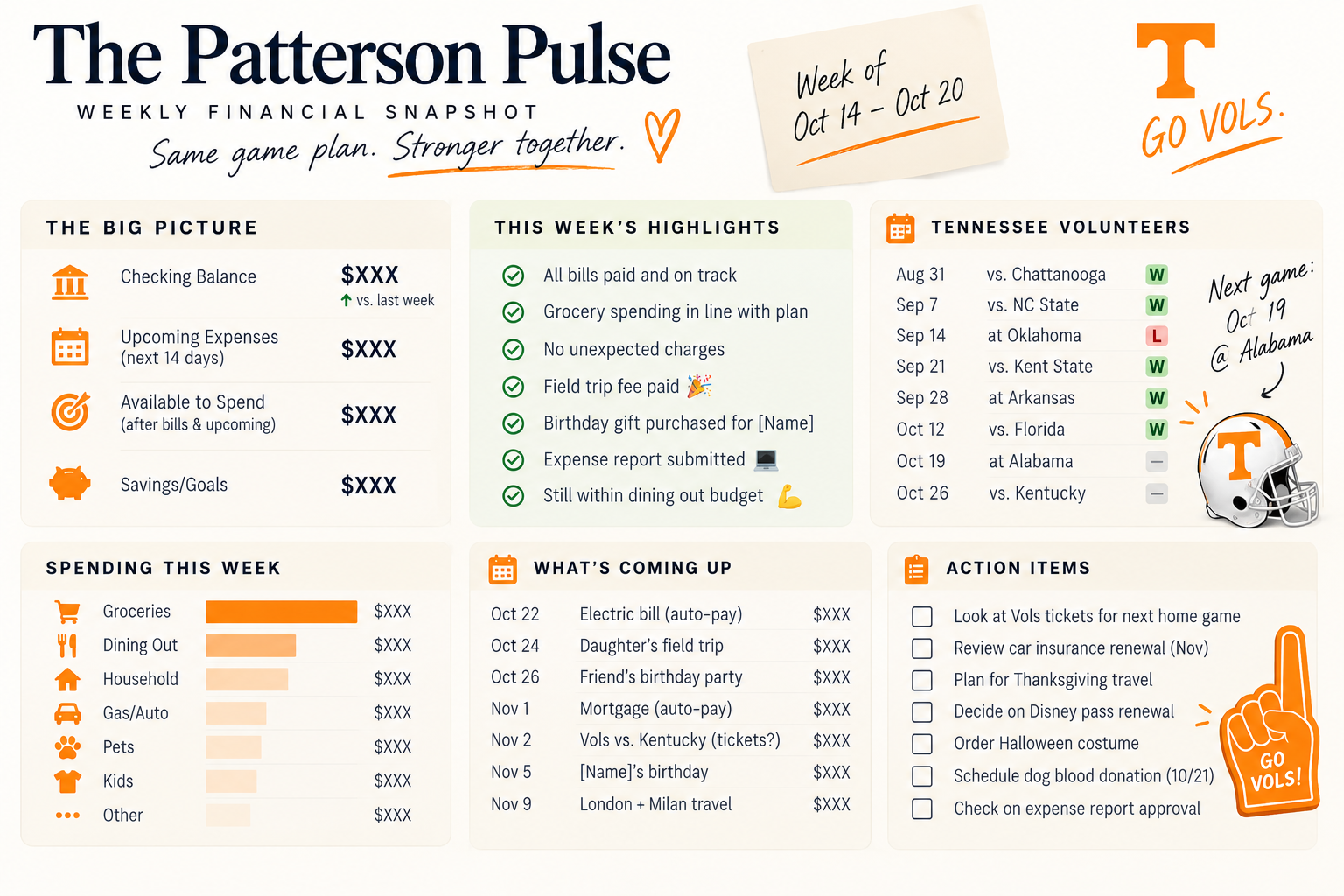
There's something amusing about using a football schedule as an engagement strategy for household financial management, but there's also a legitimate systems principle behind it. Information doesn't become useful simply because it's available. It has to be presented in a way that the intended audience can understand and is willing to engage with. I don't need Jimmy studying cash flow forecasts or debating the merits of debt reduction versus investing. I need him to have a clear picture of our priorities and enough visibility to participate in the decisions that affect us both.
There's also a practical benefit to making our financial information more accessible to both of us. Right now, I'm the person who knows where the money goes, which bills are coming, and how the various pieces fit together. But what happens if I'm traveling, sick, or simply unavailable? Shared visibility isn't just about distributing the mental load. It's also about making sure our household can function without relying entirely on one person's institutional knowledge.
We've also connected my calendar to the process, which allows us to anticipate expenses that haven't become transactions yet. Family birthdays, classmates' birthday parties, school field trips, holidays, and other events often come with financial obligations that don't appear in a traditional monthly budget. They're not exactly unexpected expenses, because we generally know they're coming. We just don't always remember to account for them until it's time to buy a gift, pay a fee, or pick something up for the occasion.
By bringing calendar events into our financial planning, we're beginning to connect what's happening in our lives with the expenses likely to follow. A birthday party invitation becomes a reminder to budget for a gift. A school field trip becomes an upcoming obligation rather than a last-minute surprise. And a cluster of family birthdays becomes something we can plan for instead of a series of transactions that mysteriously appear throughout the month.
It's a relatively simple concept, but it's also one of my favorite examples of why I wanted to build something more comprehensive than another spreadsheet. The goal isn't just to organize financial information. It's to connect information that ordinarily lives in separate places so we can make better decisions before those decisions become urgent.
The interesting part wasn't the math. It was what we started finding.
One of the first things this process exposed was how many expenses had become practically invisible. A subscription here, a recurring service there, something we'd signed up for years ago that was still quietly charging us every month. None of these discoveries was necessarily life-changing on its own, but collectively they raised a pretty obvious question: why were we continuing to pay for things we weren't consciously choosing to keep?
We also started looking more closely at categories where our assumptions didn't necessarily align with reality. A handful of relatively small purchases could create a spending pattern that was considerably more significant than either of us realized. The issue wasn't always one outrageous transaction. Sometimes it was the frequency of perfectly ordinary ones.
And then there was the distinction between money in the bank and money actually available to spend.
This one sounds obvious until you start looking at how cash moves through a household. A work reimbursement, for example, might temporarily make your checking account look healthier, but if that money is already committed to covering expenses someone else advanced, it isn't additional disposable income. Likewise, a paycheck arriving doesn't mean the entire balance is available if several obligations are coming due before the next one.
A checking account balance is a snapshot. It isn't a forecast.
What I really wanted was the ability to look ahead and understand not just what we'd spent, but what was likely to happen next. Which bills were approaching? What irregular expenses needed to be accounted for? Were we approaching a spending limit in a particular category? Could we make a purchase today without creating unnecessary pressure two weeks from now?
Even a simple two-week outlook can change the conversation. Instead of asking whether the current bank balance can cover a purchase, we can consider what that purchase would leave available after upcoming commitments. Sometimes the answer might be that something should wait until payday. The important part is having the information to make that decision before the money leaves the account.
And that's when I started realizing that what we're building isn't really just a budgeting system. It's a decision-making system.
The transaction history matters because it provides context, but the real value comes from what we do with that information. Should we make this purchase now or wait? Are we actually on track to meet a financial goal, or does the math only work if nothing unexpected happens? What tradeoffs are we willing to make today to create more flexibility tomorrow?
Traditional budgeting tells you what you intended to do. Transaction history tells you what you've already done. I want a system that helps us connect those two things and make better decisions about what to do next.
And then there's the matter of my paycheck.
As if ordinary household cash flow weren't complicated enough, my compensation structure adds another layer.
In addition to my regular salary, I receive quarterly commissions and bonuses tied to sales performance, both my own and my team's. That means four times a year, there's the potential for additional income that isn't necessarily predictable in either timing or amount.
Historically, figuring out what to do with those payments has been its own exercise. How much should I realistically expect after taxes? Which upcoming obligations need to be covered? Should we prioritize building savings, paying down debt, making an additional payment toward the car or mortgage, or exploring investment opportunities?
And if we're considering investments, how do we evaluate the tradeoffs between keeping money accessible, putting it into something relatively predictable like a certificate of deposit, or investing in the stock market?
These are not questions with universally correct answers. They depend on interest rates, liquidity, risk tolerance, timing, and what else is happening in our lives. They're also the kinds of questions that can consume an entire afternoon of research if you're trying to evaluate several possibilities at once.
So we've started using AI to help model scenarios.
What happens if a commission payment comes in at the lower end of expectations? What if it exceeds them? How much should be reserved for known expenses before allocating anything else? What would paying down a particular debt save in interest? And what flexibility would we sacrifice by making that payment instead of keeping the money accessible?
Suddenly, instead of approaching each commission payment as an isolated financial event, I can evaluate it within the context of our broader household priorities.
More importantly, I can begin that analysis before the money arrives.
There's a significant psychological difference between receiving a larger-than-usual paycheck and wondering what to do with it, versus receiving that paycheck with a plan already in place. Of course, projected commissions aren't guaranteed income, tax estimates aren't actual paystubs, and investment comparisons aren't promises of returns. But the purpose of scenario planning isn't to predict the future perfectly. It's to prepare for several reasonable possibilities.
And for someone whose income includes meaningful variability, that's an incredibly useful capability.
Of course, the robot has also been wrong.
I think it's important to be transparent about this part, because I don't want anyone reading this and assuming I've discovered some magical AI solution that flawlessly manages our household finances while I go about my day.
I have not.
There have been moments when AI missed an upcoming expense, misunderstood the purpose of a transaction, made an incorrect assumption, or presented a financial picture that was incomplete. And given that I'm relying on this information to make actual decisions about our money, I have not always responded with tremendous patience.
There's something uniquely irritating about building a system to reduce your mental load and then discovering that you still have to check its homework.
But that experience has also reinforced something I understand very well professionally: a system is only as reliable as its underlying information, assumptions, and controls.
AI can help analyze transactions, but it doesn't automatically know the story behind every purchase. It can model cash flow, but only if the relevant obligations are accounted for. It can identify patterns, but those patterns are only as meaningful as the data being examined. And depending on how the workflow is configured, it may still require human input to retrieve information, reconcile balances, and verify that nothing has been missed.
So we've had to establish rules. Unrecognized transactions need clarification rather than guesswork. Reimbursements need to be distinguished from income. Pending expenses need to be accounted for without being counted twice. And when the numbers don't reconcile, the answer isn't to make them look tidy. It's to figure out why.
In other words, the AI isn't replacing financial judgment. It's helping create a process through which that judgment can be exercised more consistently.
And because we're dealing with financial information, I'm also mindful that convenience shouldn't come at the expense of privacy or security. What information gets shared, which services have access to it, and how that information is handled are all part of designing a responsible system.
The technology is powerful, but it still requires supervision. At least for now, the household CFO has not been relieved of her duties.
The real problem was cognitive load.
Here's what I've been thinking about as this experiment has evolved.
I don't particularly mind complexity. In fact, I enjoy it. I like finding patterns, connecting seemingly unrelated information, understanding why something is happening, and figuring out how to make a process work better.
What I don't enjoy is having to keep every piece of information actively running in my head.
There's a difference between thinking deeply about a problem and being forced to remember that the electric bill is due Thursday, a quarterly payment is approaching, the dog has an appointment next week, our daughter needs new shoes, and we should probably figure out what we're doing about dinner.
One is analysis. The other is an unpaid background process running approximately 47 browser tabs at once.
For a long time, I think I confused my ability to carry that mental load with an obligation to keep carrying it. Because I was capable of managing the details, I simply continued doing so, even when the process itself was inefficient.
And that's what makes this experiment interesting to me beyond the financial implications.
I'm not trying to outsource responsibility for our money. I'm trying to build infrastructure that makes exercising that responsibility less exhausting.
A system that can hold the details so I can spend more time making decisions. A system that can recognize patterns without requiring me to rediscover them every month. A system that makes information more accessible to both adults in our household, rather than relying on one person's memory and mental arithmetic.
In my professional life, we wouldn't consider it good operational design to have one person privately maintaining all the financial information while everyone else made decisions without access to the underlying numbers. We'd establish reporting, forecasts, accountability, and some reasonable level of shared visibility.
Yet somehow, in our homes, we routinely operate exactly that way.
And perhaps that's the most important realization I've had through this process. I didn't necessarily need to become better at remembering things. I needed to stop designing my life around the assumption that I would remember everything.
We're still building it.
I want to be careful not to turn this into a triumphant story about how artificial intelligence fixed our finances, because it hasn't.
We're still early in the experiment. We still have spending habits to examine, financial priorities to establish, decisions to make, and conversations that won't become any less necessary simply because we have better reporting.
Visibility doesn't automatically create discipline. A forecast doesn't prevent an unexpected expense. And a beautifully organized financial dashboard doesn't magically produce more money. A system can make the consequences of a decision visible, but it cannot make the decision for us.
Sometimes better visibility actually makes things more uncomfortable, because it's harder to ignore a pattern once you've seen it clearly. But I think that's progress. For years, I kept returning to the same basic exercise: figure out what we owe, estimate what should be left, and hope reality cooperates. Now, for the first time, I'm building a process that can help us understand why reality doesn't always match the plan.
I'm particularly interested in what happens as we continue refining the system. Will it actually reduce the time I spend managing our finances? Will having better information change our spending behavior? Will my husband find his weekly reports useful? Will we make more intentional decisions about commission payments and long-term financial goals?
I don't know yet. Those are outcomes we still have to measure, and I'm not interested in declaring victory just because I've built something with a clever name. There's also a cost to maintaining any system. If I end up spending as much time supervising the process as I previously spent doing the analysis manually, then we haven't really solved the problem.
What I do know is that the questions we're asking have changed. We're looking beyond what we owe and examining what we actually spend. We're thinking further ahead instead of relying exclusively on what's in the checking account today. And we're beginning to create a shared understanding of our financial priorities rather than leaving so much of that information inside my head.
We're also trying to build a system for the family we hope to have in the years ahead, not just the household we're managing today. The financial needs of a family aren't static. Children grow, circumstances change, opportunities arise, and priorities evolve. I don't want to rebuild our entire approach every time life introduces a new variable. I'd rather have a framework flexible enough to adapt along with us.
As someone who believes deeply in stewardship, that's important to me. We've been blessed with opportunities and resources that I don't want to take for granted, and I want to be intentional about how we use them. Not just for our immediate needs, but for our family's future, the things we hope to accomplish, and the ability to be generous when opportunities arise.
I spent years building a career that would give our family greater financial freedom. It seems only reasonable that I should invest some energy into building the systems that help us protect and use that freedom wisely.
Artificial intelligence isn't particularly interesting to me because it can produce a budget or generate a colorful chart. We've had tools capable of doing those things for decades. What's interesting is that it makes a level of analysis and ongoing refinement accessible to people who previously might not have had the time, technical expertise, or patience to maintain it.
It lowers the barrier between having information and actually doing something useful with it.
For someone with a systems-minded brain and a life that seems to acquire new moving parts every time I blink, that's a pretty compelling proposition.
I don't need a perfect financial system. I need one that's reliable enough to be useful, flexible enough to evolve, and simple enough that we'll actually continue using it. Ultimately, I want to spend less time wondering where our money went and more time making thoughtful decisions about where it should go.
And if, somewhere along the way, we can retire vibes as our primary household financial management strategy, I'd consider that a pretty respectable return on investment.
P.S. I'm taking requests. 😊
I've spent a lot of time writing about what's happening in my own little corner of the world, but I'd love to hear what's happening in yours.
Is there something you'd like me to write about? A topic you're curious about? A problem you've been trying to solve that could use a fresh perspective (or an unnecessarily enthusiastic systems brain)?
I'm genuinely curious about what you'd find interesting, helpful, or even just entertaining. And while I can't promise I'll have all the answers, I'm more than willing to think through a problem with you.
Leave a comment, reply to this email, or send me a message. I'd love to hear from you!